KZ
Kazakhstan
Steppe wilderness meets futuristic Astana
Steppe wilderness meets futuristic Astana

A 300m deep canyon of red sandstone in the desert near Almaty: the Valley of Castles formation resembles the American Southwest. 3h drive from Almaty.
Photo: Bgag, CC0

A turquoise lake formed by a 1911 earthquake landslide: the dead fir trees still stand 12m above the water. Accessible by 4WD from Almaty.
Photo: Katariyakartikey, CC0

Three glacial alpine lakes at ascending altitudes in the Tian Shan: a 2-day trekking circuit popular with Almaty weekenders.
Photo: Katariyakartikey, CC0

A glacial reservoir at 2,510m directly behind Almaty: accessible by car in 45 minutes, with the Tian Shan peaks reflected in turquoise water.
Photo: МаратД, CC BY-SA 4.0

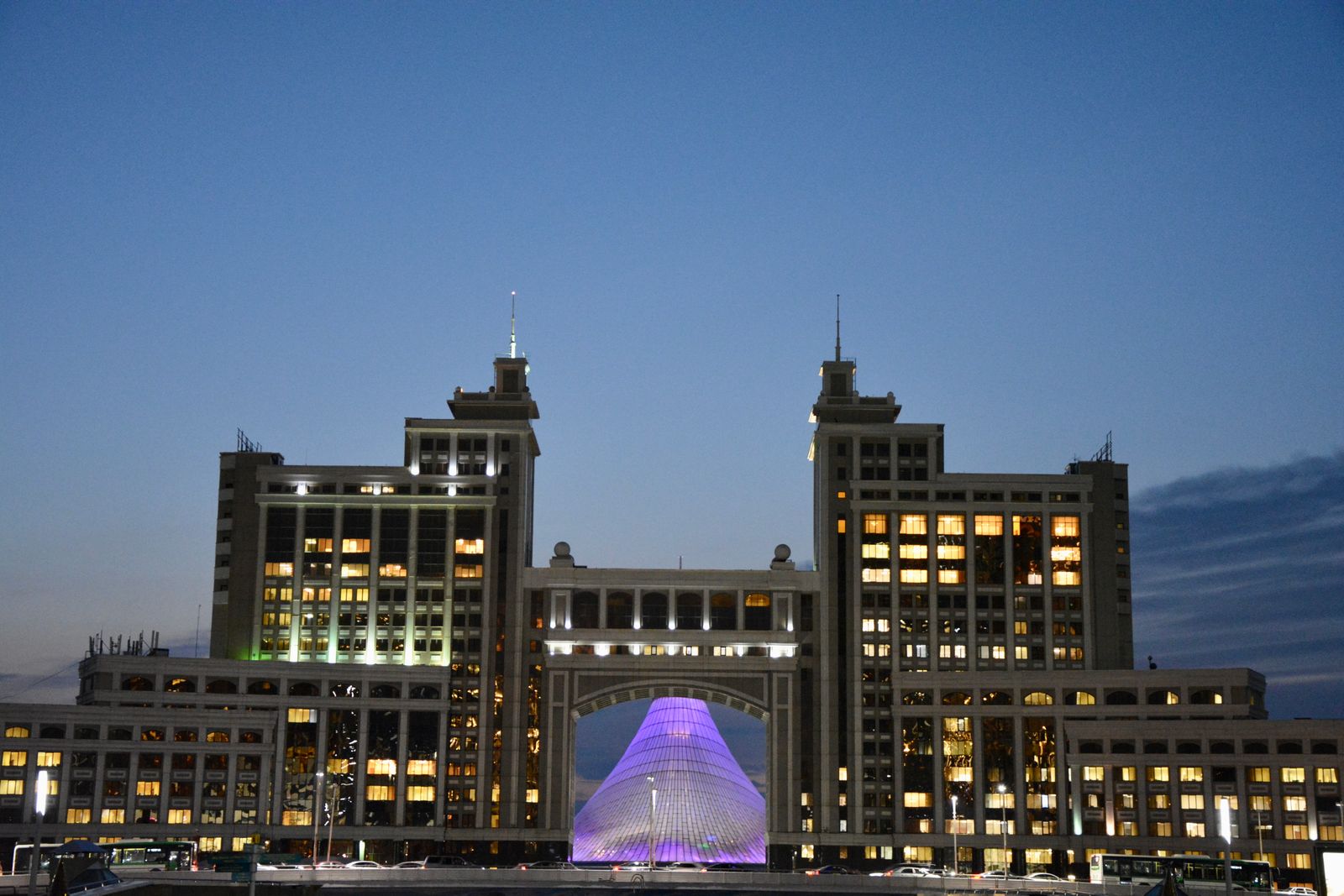
A planned capital of architectural ambition: the Baiterek Tower (97m, golden sphere), the Khan Shatyr entertainment centre (the world’s largest tent structure) and the Palace of Peace and Reconciliation pyramid.
Photo: Ken and Nyetta, CC BY 2.0

The Barchan sand dune that emits a singing sound when the wind blows: and the Przewalski’s horse (reintroduced from captivity) in a desert park.
Photo: Sane4o, CC BY-SA 4.0

The world’s first and largest space launch facility: where Sputnik, Yuri Gagarin and all Soviet manned missions launched. Accessible by special permit from Moscow or Baikonur city.
Photo: Bill Ingalls, Public domain

Kazakhstan’s third city: the most Uzbek-flavoured city in Kazakhstan, with a bazaar culture and the most accessible entry point to southern Kazakhstan.
Photo: Rassim, CC BY-SA 3.0
Boiled lamb or horse meat on flat noodles with onion broth: literally “five fingers” (eaten by hand). The national dish of Kazakhstan, served at every celebration.
Dried smoked horse intestine sausage: the most prized cold meat in Kazakhstan, eaten at New Year and special occasions.
A clear lamb and vegetable broth: the standard soup of Kazakhstan’s traditional cooking.
Deep-fried dough pillows: the universal Kazakh sweet bread, served with tea at every gathering and celebration.
Slightly fizzy, mildly alcoholic fermented mare’s milk: the traditional nomadic drink of the steppe. Acquired taste. Offered at every yurt stay.
Russian vodka culture is strong: shared at every Kazakh gathering with toasts.
A Kazakh lager brewed in Shymkent since Soviet times.
Baked pastry filled with lamb and onion: shared with Uzbek cuisine.
Almaty International (ALA) and Nur-Sultan Nazarbayev (NQZ) are the two main hubs. Air Astana is the national carrier with an excellent network; Turkish Airlines and Lufthansa serve European routes. For trip planning, see the official Kazakhstan tourism portal.
Air Astana operates direct flights from London, Amsterdam and Frankfurt to both Almaty and Astana. Turkish Airlines via Istanbul is a strong alternative with competitive fares.
Dubai is the most convenient Middle East hub for Kazakhstan. The combination of Kazakhstan with Uzbekistan (Tashkent 2h from Almaty) and Kyrgyzstan (Bishkek 40 min) makes a natural Central Asia circuit.
The Almaty Metro (2 lines, 11 stations, KZT 80) covers the central city. Yandex Go and inDrive are the main taxi apps.
Car hire in Almaty (KZT 8,000–20,000/day) is the most practical option for Charyn, Kolsai and the mountain circuit. The A2 highway east is paved and good; mountain roads require care in wet conditions.
May to September is the best window — Almaty’s mountains open, the Charyn Canyon hike-able, the Kazakh steppe green (May–June). July and August are the warmest (25–32°C). Nur-Sultan (Astana) can be visited year-round but January averages -15°C. The apple orchards above Almaty flower in April.
📅 Kazakhstan is in its best season in May, June, July, August, September. See where else is good to go in those months, or browse where to go by month.
Kazakhstan is mid-range — comparable to Russia or Eastern Europe, with excellent local food very affordable and accommodation ranging from budget guesthouses to Almaty’s new luxury hotels. The Kazakhstani Tenge (KZT) is the currency.
Beshbarmak (“five fingers” — boiled horse or sheep meat served on wide flat noodles and onion sauce, eaten with the hands — is the national dish of Kazakhstan, prepared for celebrations and served on a large shared)
Shymbulak ski resort above Almaty (2,200–3,200m, 35km of piste, excellent snowfall, lift ticket KZT 8,000–15,000/day) is the most affordable ski resort in the world at European ski standards — the equipment.
The Ritz-Carlton Almaty (opened 2020, the tallest building in Almaty, with the finest restaurant and spa in Central Asia) and Rixos Astana are Kazakhstan’s premier addresses — from KZT 60,000–150,000/night.
Almaty for two days, Charyn Canyon for one, the Kolsai Lakes for one, Big Almaty Lake for one, Astana (Nur-Sultan) for two. Kazakhstan — the world’s ninth-largest country — has the most dramatic mountain scenery in Central Asia, the world’s largest landlocked country and a capital city built from scratch in the steppe.
Almaty (population 2 million, the former capital) sits below the Tian Shan mountains — snow-capped peaks visible from the city centre, the Medeu speed skating rink (the highest in the world at 1,691m, with a natural ice surface of 10,500m²) and the Shymbulak ski resort (2,200m, 35km of pistes). The Zenkov Cathedral (1907, entirely built of wood without nails, survived the 1911 earthquake).
The city of Almaty (formerly Alma-Ata — “Father of Apples”) gives its name to the wild apple (Malus sieversii), which geneticists confirmed in 1998 is the ancestor of all cultivated apple varieties worldwide. The Tian Shan forests above Almaty contain the last wild populations of this species. Every apple ever grown on earth has its origin in these mountains.
The Zelyony Bazaar (Green Market — the finest Central Asian bazaar in Kazakhstan, covered, with kumiss (fermented mare’s milk), 50 varieties of dried fruit, Kazakh bread and horsemeat sausage vendors who have been in the same spot for generations) and the cable car to the Koktobe hill (1,070m, views over the entire Almaty basin to the snow peaks).
Kumiss (qymyz in Kazakh) — slightly fermented mare’s milk with a mild alcoholic content (1–3% ABV) and a sour, effervescent taste — is the defining drink of the Kazakh steppe. It is produced by churning fresh mare’s milk in large leather bags (saba), a process that takes 3–4 days. Kazakhs consider it a health drink and it is served at all celebrations.
200km from Almaty. Charyn Canyon — a 90km canyon system cut by the Charyn River through red sandstone and clay, with formations up to 300m high — has been called the “younger brother” of the Grand Canyon. The Valley of Castles (a 2km walking trail through rock spires, arches and columns of Precambrian conglomerate, 25–150m high).
The Charyn ash forest (Fraxinus sogdiana — a relict species surviving from before the last Ice Age) is found only in the canyon bottom at Charyn — approximately 5,000 trees in a narrow strip of riverbank below the canyon walls. This Central Asian ash survived the Pleistocene glaciation in the canyon microclimate while its species disappeared from the surrounding steppe.
3h from Charyn. The Kolsai Lakes — three alpine lakes connected by a river, at 1,818m, 2,252m and 2,850m altitude, in a Tian Shan fir forest above the Kolsai River gorge — are the most beautiful lake system in Kazakhstan, with views over the snow peaks of the Tian Shan into Kyrgyzstan.
The Tian Shan (Celestial Mountains) span 2,800km from Uzbekistan through Kazakhstan and Kyrgyzstan to China — the highest peak is Khan Tengri (7,010m) on the Kazakhstan–Kyrgyzstan border. The range contains 18,000+ glaciers, the sources of the Amu Darya and Syr Darya rivers.
75km from Almaty. Big Almaty Lake (2,511m altitude, a reservoir of turquoise colour fed by Tian Shan glaciers, surrounded by silver fir and spruce, with peak visibility to the 4,973m Talgar massif) is the finest single mountain lake accessible from Almaty in a half day. The Ile-Alatau National Park for the afternoon hike.
Big Almaty Lake gets its turquoise colour from glacial flour — fine particles of rock ground by glacier movement suspended in the water, which scatters blue-green wavelengths. The same phenomenon produces the colour in lakes below retreating glaciers from the Alps to Patagonia.
2h flight from Almaty. Astana — the capital moved here from Almaty in 1997 at President Nazarbayev’s order, built from scratch on the frozen steppe at -35°C in winter — is one of the most architecturally audacious cities on earth. The Bayterek Tower (97m, a gilded sphere representing the egg of the mythological Samruk bird), the Khan Shatyr (a giant translucent tent/shopping centre), and the Palace of Peace and Reconciliation (a 62m glass pyramid by Norman Foster).
The Khan Shatyr (2010, designed by Norman Foster) is the world’s largest tent structure — a 150m-high ETFE-covered tent enclosing a 140,000m² interior that maintains a subtropical climate (year-round temperature 15–30°C) inside while the exterior drops to -35°C in winter. It contains a beach resort, a river, shopping and a golf course.
The EXPO 2017 site (Kazakhstan hosted the World’s Fair on the theme of Future Energy — the Nur Alem sphere, the world’s largest spherical building at 80m diameter, now a museum of future energy technologies) and the Palace of Peace and Reconciliation (a 62m glass pyramid by Norman Foster, used for the Congress of Leaders of World and Traditional Religions). Fly from Astana (NQZ).
The Nur Alem sphere at EXPO 2017 is the largest glass sphere in the world — 80m in diameter, clad in glass photovoltaic panels, containing a full museum of global energy technologies across 8 floors. It was designed to rotate to track the sun; the rotation mechanism was never activated.
The dominant ride-hailing app in Kazakhstan.
A restaurant meal: KZT 2,000-5,000 (EUR 4-10). Almaty hotel: EUR 50-100.
Kazakhstan is enormous: Almaty to Astana: 2h flight. Train: 12h.
The hospitality tradition is strong: refusing food or tea is awkward.
Beeline has the best coverage in remote areas.
Thank you and hello in Kazakh: appreciated.
The Tian Shan can have snow any month above 3,000m.
Russian and Kazakh cultures blend comfortably here.
Quick answers to the questions people most often ask before visiting Kazakhstan.
Fly into Almaty (ALA) or Astana (NQZ), the two main hubs. There are direct flights from London (about 7 hours) and Istanbul (about 4h30), plus connections via Frankfurt, Dubai and other hubs.
May to September, when the mountains around Almaty and Charyn Canyon are accessible; May and June are when the steppe is greenest. Astana is very cold in winter, with January averaging around −15°C.
By domestic flight (about 2 hours) or by train (around 12 hours or more). Kazakhstan is enormous, so flying saves a lot of time on long journeys.
It is mid-range — local food is very affordable, and budget travellers can manage on around KZT 6,000–12,000 per day, while mid-range trips cost roughly KZT 25,000–50,000. The currency is the tenge (KZT).
Ride-hailing apps such as Yandex Go work well in Almaty and Astana and are the easiest way to get around. A local SIM card is cheap and useful.
The dominant ride-hailing app in Almaty and Astana — very affordable and widely available.
FreeAlternative ride-hailing across Kazakhstan — lets you set and negotiate your own fare.
FreeBook Charyn Canyon tours, Altai mountain treks, Big Almaty Lake hikes and Kazakh experiences.
FreeKazakhstan’s widely used messaging platform — most businesses and tour operators prefer Telegram.
FreeBook hotels and guesthouses in Almaty, Astana and around national parks.
FreeTrack KZT (Kazakhstani Tenge) rates — the tenge fluctuates; check before exchanging large sums.
FreeLeafy Almaty, futuristic Astana, the pilgrimage city of Turkistan, the red-rock Charyn Canyon and the alpine Kolsai Lakes — the many faces of vast Kazakhstan.
Kazakhstan sits within easy reach of several other destinations — each with a completely different character.


