RU
Russia
Tsars, taiga & the Trans-Siberian
Tsars, taiga & the Trans-Siberian
Russia is the world’s largest country by land area, a vast empire stretching from the Baltic to the Pacific across eleven time zones. Despite its complex reputation, Russia rewards the curious traveller with extraordinary cultural riches: the golden domes and medieval kremlin walls of the Golden Ring cities, the baroque grandeur of St Petersburg with the Hermitage’s three million artworks, Moscow’s electric energy and the Red Square that has witnessed centuries of Russian history. Beyond the cities lies a wilderness of staggering scale — the sacred depths of Lake Baikal, the volcanic drama of Kamchatka and the ancient Siberian taiga.
The Trans-Siberian Railway remains one of the world’s great journeys, crossing seven time zones in six days. Russia’s folk traditions, classical music and literary heritage — Tolstoy, Dostoevsky, Chekhov — give the country a cultural depth that surprises many visitors.
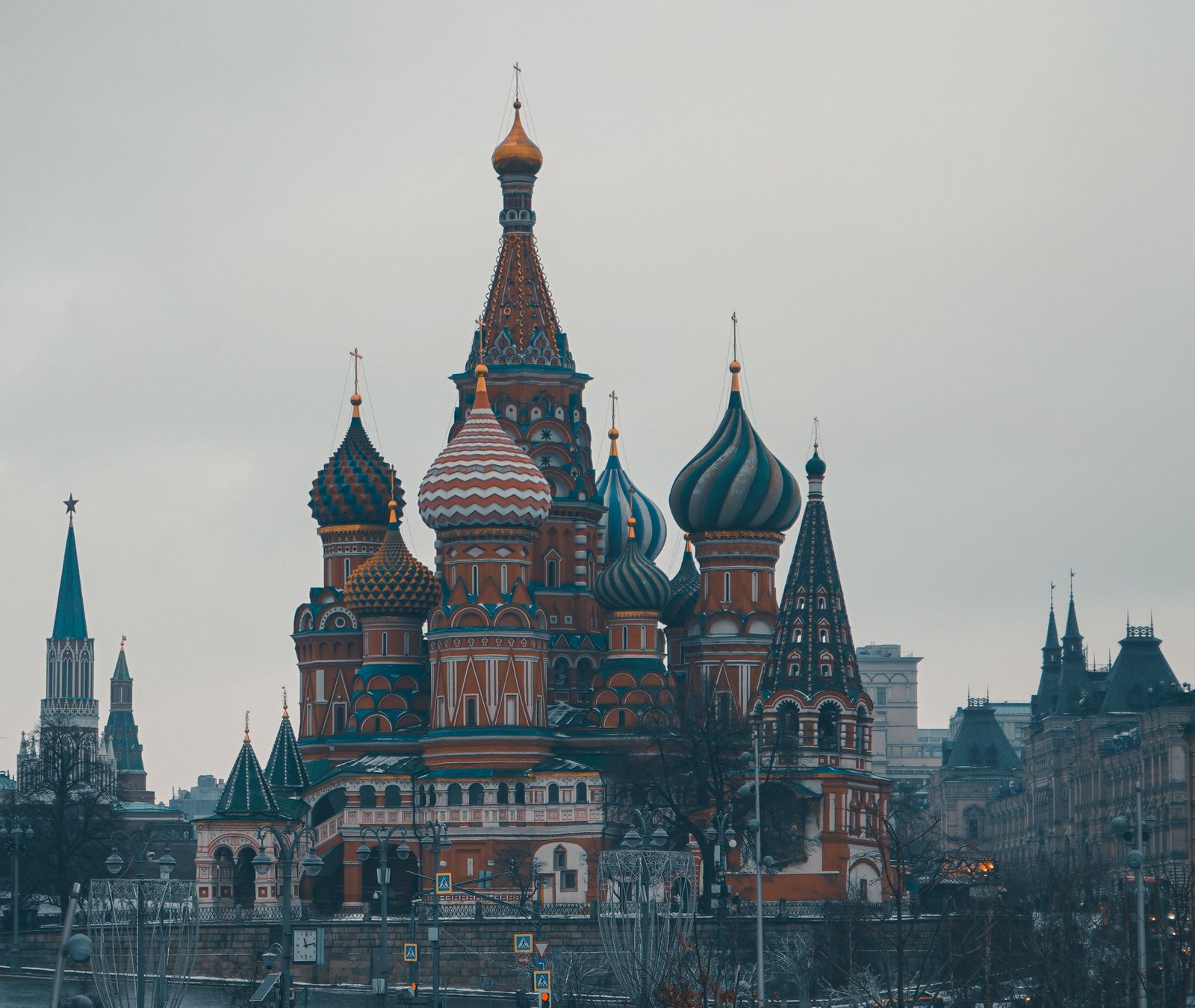
The Russian capital is anchored by Red Square and the UNESCO-listed Kremlin fortress — an extraordinary complex of palaces, cathedrals and the famous ruby-topped towers. St Basil’s Cathedral, with its riot of coloured onion domes, is one of the world’s most recognisable buildings. Beyond the Kremlin, Moscow dazzles with grand Stalinist architecture, ornate metro stations, the Tretyakov Gallery and a restaurant scene that has transformed dramatically in recent years.
Peter the Great’s window to Europe is Russia’s most beautiful city, built on 42 islands and criss-crossed by canals. The Hermitage Museum, housed in the Winter Palace, holds one of the world’s greatest art collections. The Church of the Saviour on Spilled Blood, Peterhof’s Grand Cascade, Nevsky Prospekt and the White Nights of June — when the sun barely sets — make this a city apart.
The world’s oldest, deepest and largest freshwater lake by volume sits in southern Siberia like an inland sea, holding 20% of Earth’s fresh surface water. In winter it freezes into sheets of transparent turquoise ice; in summer, shoreline trails and fishing villages offer a glimpse of pristine Siberian life. The endemic Baikal seal (nerpa) lives here and nowhere else on earth.
A loop of ancient cities north-east of Moscow — Sergiev Posad, Vladimir, Suzdal, Yaroslavl — forms one of Russia’s richest cultural circuits. These medieval towns preserve the Russia of the tsars: white-walled kremlin churches, wooden architecture, Orthodox monasteries and a pace of life seemingly untouched by the 21st century. Suzdal, with more churches than residents, is a particular highlight.
The world’s longest railway (9,289 km from Moscow to Vladivostok) is one of travel’s greatest experiences. The classic route takes six days across the Ural Mountains, the Siberian plains and around Lake Baikal. Two branch lines run to Beijing via Mongolia or Manchuria. Book a 2nd-class platzkart bunk for the full authentic experience.
This remote peninsula at Russia’s far eastern tip is one of the world’s last true wildernesses — active volcanoes, geysers, hot springs and tens of thousands of brown bears. The Valley of Geysers is accessible only by helicopter and is one of the largest geyser fields on earth. Extraordinary salmon runs draw eagles and bears in their thousands each autumn.
beetroot soup with sour cream) appears in endless regional variations.
Siberian dumplings filled with minced meat — are a national comfort food, as are
thin pancakes) served with sour cream, caviar or jam.
, a Soviet-era potato salad with pickles and mayonnaise, remains ubiquitous at celebrations.Russian black bread is exceptional — dense, slightly sour Borodinsky loaf with caraway seeds. Smoked fish — sturgeon, salmon and omul from Baikal — is a revelation. For drinks, vodka is consumed ceremonially;
a lightly fermented bread drink) refreshes in summer; and the tea ritual, served through a samovar, is central to Russian hospitality. Georgian wine and Armenian brandy are widely available and excellent value.
Sheremetyevo (SVO) and Domodedovo (DME) serve Moscow; Pulkovo (LED) serves St. Petersburg. Note: due to Western airspace restrictions on Russian carriers since 2022, routing options have changed significantly. Turkish Airlines and Emirates remain among the most accessible options. Check current entry requirements and visa rules before booking. For trip planning, see the official Russia tourism portal.
💡 Since 2022, most Western European carriers suspended Russia routes. Turkish Airlines via Istanbul and Emirates via Dubai are the most reliable options for Western travellers. Aeroflot operates from Moscow but is subject to sanctions restrictions.
💡 From Asia, Beijing (8h) and Seoul (9h) both have direct connections. Istanbul remains the most practical hub for travellers from most of the world.
💡 The Aeroexpress trains (RUB 550) are the most reliable airport connections; Moscow’s traffic can turn a 30km taxi journey into 2h at peak times. The Moscow Metro runs 24h on weekends.
💡 The Sapsan is the ideal Moscow–St. Petersburg connection — 4h, comfortable, scenic, departs from city centre. The overnight Krasnaya Strela (“Red Arrow”) is a classic Soviet-era luxury sleeper.
May to September is the best window for Moscow and St Petersburg — the long summer days (St Petersburg’s White Nights in June have 22 hours of daylight), outdoor cafe culture, museums without winter coats. June and July are the warmest months (20–25°C). Note: Western tourists should check current visa and entry requirements carefully.
Note: Western payment cards may not work in Russia due to sanctions. Russia is generally affordable for European standards, though access and payment methods should be researched carefully before travel. The Russian Ruble (RUB) is the currency.
Pelmeni — small pasta dumplings filled with minced pork, beef or lamb, boiled and served with sour cream (smetana) or butter — are Russia’s most important comfort food, eaten across all social classes at any hour.
Georgian wine — from the Kakheti region, the oldest continuously winemaking culture in the world (8,000 years) — is the preferred wine of Moscow and St.
The Four Seasons Moscow (on Okhotny Ryad, adjacent to the Kremlin, occupying the rebuilt Moskva Hotel, with views directly over Red Square from the upper-floor rooms) is the finest address in Moscow.
Moscow for three days, the Golden Ring for one, St. Petersburg for three. Russia — the world’s largest country — has two of the greatest cultural capitals in Europe, the most ambitious tsarist architecture on earth and a tradition of ballet, opera, literature and visual art that rivals any nation. Note: check travel advisories before visiting.
Moscow — a city of 13 million, rebuilt in Stalinist Imperial style across its historic core — with the Kremlin (a 27.5-hectare fortified complex with five palaces, four cathedrals and 20 towers, the seat of Russian power since 1325, now the official residence of the President), the Red Square (the most recognisable plaza in Europe — the Lenin Mausoleum, the colourful onion domes of St. Basil’s Cathedral, the GUM department store and the Kremlin wall all within 200m).
💡 St. Basil’s Cathedral (1555–1561, commissioned by Ivan the Terrible to commemorate his victory over the Mongol Khanate of Kazan) is the most recognised building in Russia. Its multicoloured onion domes were not originally coloured — the original 16th-century structure was white with golden domes; the vivid colours were added in the 17th century. Legend that Ivan the Terrible blinded the architects to prevent them building anything more beautiful has no historical basis.
The Tretyakov Gallery (the finest collection of Russian art in the world, 130,000 works, from 11th-century icons through the Wanderers movement to Avant-Garde — Repin’s 1891 Ivan the Terrible and his Son Ivan dominates Room 32), the Moscow Metro (1935, with 44 stations decorated as palaces of the people — Komsomolskaya, Novoslobodskaya and Kievskaya are the most ornate), and the Bolshoi Theatre (Russia’s national ballet and opera company, founded 1776).
💡 The Moscow Metro stations of the Circle Line (1950) were designed as the most beautiful public spaces in the USSR — Komsomolskaya Station has a yellow ceiling covered in Soviet mosaic panels depicting military victories, supported by marble columns with gilded capitals. The metro serves 9 million passengers daily; each station was designed by a different architect in competition with all the others.
Gorky Park (Maxim Gorky Central Park of Culture and Rest, 2.2km along the Moscow River, redesigned by Danish urban planners in 2011 into Moscow’s finest public space) and the Pushkin State Museum of Fine Arts (the finest collection of non-Russian European art in Russia — 670,000 works, including Rembrandt, Velazquez and the Impressionist collection acquired by Sergei Shchukin).
💡 The Shchukin collection at the Pushkin Museum — 256 paintings by Monet, Gauguin, Picasso and Matisse acquired by Moscow textile merchant Sergei Shchukin between 1898 and 1914 — was the largest private Impressionist and Post-Impressionist collection in the world. Nationalised by the Bolsheviks in 1918, it remains in Moscow and St. Petersburg; the story of its acquisition is the subject of a major 2021 film.
2h from Moscow. Sergiev Posad (the Trinity Lavra of St. Sergius — the most important Russian Orthodox monastery, founded 1337, with five cathedrals, golden domes, and the cell of St. Sergius — the most revered person in Russian history) and Suzdal (a perfectly preserved medieval Russian town with 53 Orthodox churches for a population of 10,000 — the most church-dense town in Russia).
💡 The Trinity Lavra of St. Sergius at Sergiev Posad is the spiritual heart of the Russian Orthodox Church — it has been continuously inhabited by monks since 1337 (except for a brief Soviet-era closure). The Cathedral of the Assumption (1559–1585, commissioned by Ivan the Terrible, with ultramarine domes covered with gold stars) contains the relics of St. Sergius and is a place of pilgrimage for millions annually.
4h on the Sapsan high-speed train (250km/h, Moscow Leningradsky → St. Petersburg Moskovsky). St. Petersburg — founded by Peter the Great in 1703 on a Neva River delta (the city was built on 42 islands connected by 342 bridges) as Russia’s “window to Europe” — is one of the finest planned cities on earth: the Winter Palace, the Hermitage and the great Baroque-Neoclassical ensemble of the Palace Square.
💡 Peter the Great founded St. Petersburg in 1703 by conscripting 40,000 serfs and soldiers per year to build on the marshy delta of the Neva River — an estimated 30,000 workers died during construction. The city was built on wooden piles driven into the mud; the foundations of the Winter Palace rest on 10,000 wooden stakes, which have been preserved by the cold, anaerobic mud since 1762.
The State Hermitage Museum (the largest and one of the most important art museums in the world — 3 million objects in 350 rooms of the Winter Palace and adjacent buildings, including the finest Impressionist collection outside France, Leonardo’s Benois Madonna, and 600,000 drawings) — can realistically cover 4–5 rooms per visit. The Neva embankment at sunset.
💡 The Hermitage’s collection of approximately 3 million items could not be seen in its entirety in a lifetime of daily visits — if you spent one minute looking at each object and worked 8 hours a day, it would take 15 years. The museum acquires new items and each year and continues to expand; large portions of the collection are in storage at any given time.
The Peterhof Palace (18km west by hydrofoil, “the Russian Versailles” — 147 fountains powered entirely by gravity through an 18th-century hydraulic system, with the Grand Cascade of 64 gilded sculptures, one of the finest garden spectacles in Europe) and the June White Night (the sun barely sets — 22 hours of daylight; people walk the embankments at midnight in daylight). Fly from Pulkovo (LED) or Domodedovo (DME).
💡 Peterhof’s Grand Cascade fountain system (designed by Peter the Great himself, completed 1723) operates entirely without pumps — water is channelled from springs 22km inland through a system of pipes and channels at a precise height differential that generates the pressure for 147 fountains simultaneously. The system has operated continuously since 1723 except during WWII Nazi occupation.
Most nationalities require a visa. An e-visa is available for 55+ countries for single-entry visits. Check current requirements carefully as they change frequently.
Moscow and St Petersburg’s metro systems are efficient and architecturally spectacular — among the world’s finest. Long-distance trains are comfortable and punctual.
Learning a few Cyrillic letters to read signs and metro stations is genuinely helpful. English is spoken in tourist areas of major cities but limited elsewhere.
Cash (rubles) is essential outside major cities. Western bank cards may not function — check current conditions and carry adequate cash.
Russian winters are extremely cold; Moscow averages −10°C in January. Summer is warm and pleasant. The White Nights of St Petersburg (Jun–Jul) are magical.
— Russia’s dominant mapping app, more accurate than Google Maps for Russian cities and public transport, with offline capability.
Free— The main ride-hailing app, widely used across Russia and more reliable than street taxis for foreign visitors.
Free— Excellent offline maps and city directories, particularly useful in smaller cities where other maps have limited coverage.
Free— Official Russian Railways app for booking Trans-Siberian and long-distance trains in advance.
Free— Camera translation of Cyrillic text is invaluable for menus, signs and transport schedules.
FreeReal-time and offline exchange rates for all world currencies — converts prices instantly so you always know what you are paying in your home currency.
FreeRussia sits within easy reach of several other destinations — each with a completely different character.


