NC
New Caledonia
French cuisine meets Melanesian culture on the world's finest lagoon
French cuisine meets Melanesian culture on the world's finest lagoon
New Caledonia is a French overseas territory in the southwestern Pacific — a hybrid of Polynesian and Melanesian culture, French cuisine and colonial architecture, set against one of the world’s most striking natural environments. The New Caledonian Barrier Reef, the second-longest in the world (after Australia’s Great Barrier Reef) and a UNESCO World Heritage Site, encloses a lagoon of size and diversity. Nouméa, the capital, has the most European character of any Pacific city — excellent French restaurants, a sophisticated arts scene and excellent beaches within 15 minutes of the centre. The Kanak Melanesian culture, one of the Pacific’s richest, is powerfully expressed in the TJIBAOU Cultural Centre, designed by Renzo Piano.
The largest UNESCO-listed lagoon in the world — 24,000 square kilometres of turquoise water enclosed by the world’s second-longest barrier reef. The lagoon’s diversity of habitats (sea grass beds, mangroves, coral gardens, deep channels) supports dugongs, sea turtles, humpback whales (Jul–Sep), manta rays and over 1,000 species of fish. The northern lagoon near Hienghène has particularly dramatic limestone cliff scenery.
Designed by Renzo Piano and opened in 1998, the Tjibaou Cultural Centre is the finest example of contemporary Melanesian architecture — ten large curved structures inspired by the traditional Kanak grande case (chief’s house) rise from a peninsula of tropical forest in Nouméa. The centre is the spiritual and cultural heart of Kanak identity, named after the independence leader Jean-Marie Tjibaou.
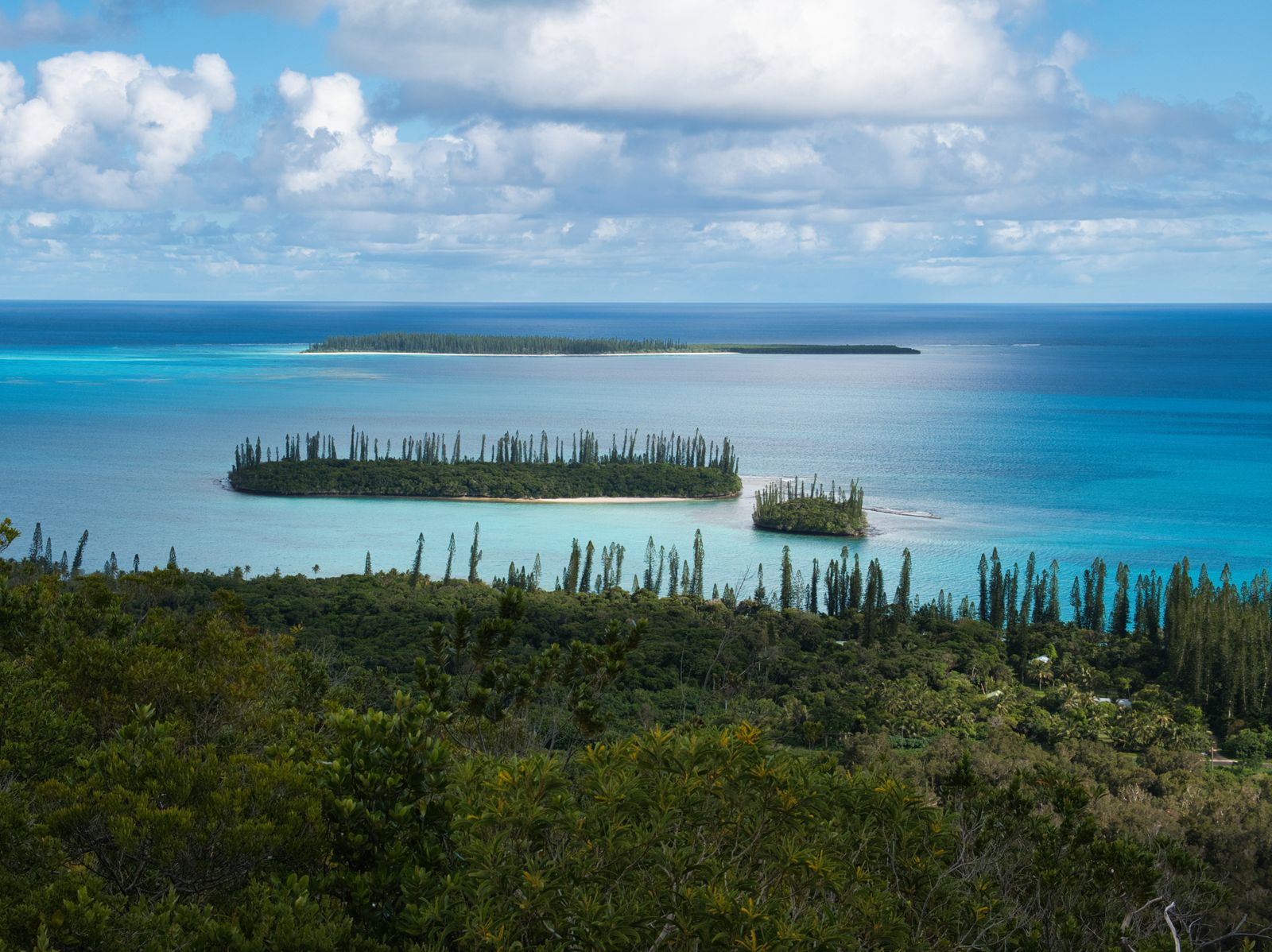
The most beautiful island in the Pacific according to many who have visited — the Isle of Pines earns its reputation with a natural swimming pool of Cleopatra Bay (a vast, shallow, turquoise lagoon), tall columnar pines unique to New Caledonia, white-sand beaches and clear water of high quality. An easy day trip or overnight from Nouméa by air or boat.
The most French city in the Pacific has excellent restaurants (fresh Pacific fish prepared with French technique is outstanding), the Tina’s beach market, the Musée de Nouvelle-Calédonie and a café culture that would not embarrass the boulevards of Nice. The waterfront Moselle Bay and Anse Vata Beach are the social heart of the city.
The traditional Kanak dish: chicken, fish or lobster with yam, taro, banana and coconut cream, wrapped in banana leaves and cooked on hot stones.
Deer (cerf), introduced in the 19th century, is a local speciality, alongside prawns, crab and lagoon fish.
The French influence means fresh baguettes every morning, even in small villages.
Nouméa’s bakeries turn out croissants, pain au chocolat and fruit tarts in classic French style.
A beachside café au lait is the morning ritual. French wine is widely available, and kava bars are popular in the evening.
The local lager, brewed in Nouméa and sold at beach bars and supermarkets across the islands.
Nouméa La Tontouta (NOU) is the main international airport. Air New Zealand, Qantas, Aircalin (Air Caledonie International) and Air France (via Sydney) serve the main routes. For trip planning, see the official New Caledonia tourism portal.
Sydney (2h30) and Auckland (3h) are the closest major gateways. New Caledonia sits between Australia and Fiji on the main Pacific routes.
From Europe, Sydney or Auckland are the most practical gateways — route via Singapore or Tokyo. Tokyo has a direct Aircalin connection in 7h.
Air Caledonie (domestic) covers all island hops from Nouméa La Magenta airport (the domestic terminal in the city) — a separate airport from the international terminal.
Grande Terre has a good main road (RPN1) north of Nouméa; car hire (XPF 4,000–8,000/day) is the most practical option. The outer islands are compact enough to explore on bicycle or scooter.
June to October is peak — dry, cooler (21–25°C), the lagoon flat and clear, the best diving. July and August are the most pleasant. November to April is the wet season — humid and hot (27–31°C) with occasional cyclone risk, though the lagoon remains beautiful.
📅 New Caledonia is in its best season in April, May, June, July, August, September, October, November. See where else is good to go in those months, or browse where to go by month.
New Caledonia uses the CFP franc (XPF), pegged to the euro. It is one of the most expensive destinations in the Pacific — comparable to French Polynesia, with French import prices on most goods.
Bougna — the Kanak earth-oven dish — costs XPF 1,200–3,000 at a market or Kanak restaurant and represents one of the most authentic and affordable local food experiences in the Pacific.
New Caledonian rosé wine (produced in small quantities from the Domaine de Doniambo and other estates near Nouméa, from Mediterranean varietals in a subtropical climate) costs XPF 1,500–3,500 per bottle and represents.
Le Méridien Île des Pins (directly on the turquoise Kuto Bay, the finest resort in New Caledonia, from XPF 30,000–80,000/night) is the Pacific benchmark for French colonial luxury.
Nouméa for two days, the Île des Pins for two, the north for one, the Loyalty Islands for one. New Caledonia — a French collectivity in the southwest Pacific — has the world’s largest coral lagoon and the finest French food in the Pacific.
Nouméa — the capital of New Caledonia, a French special collectivity in the southwest Pacific, on a peninsula surrounded by the world’s largest lagoon (UNESCO World Heritage — 24,000km² of turquoise water enclosed by the second-longest coral barrier reef in the world at 1,600km) — with the Tjibaou Cultural Centre (Renzo Piano, 1998, the finest building in the Pacific, celebrating Kanak culture).
The Tjibaou Cultural Centre (designed by Renzo Piano, inspired by traditional Kanak case (hut) architecture, with 10 bamboo-clad curved towers representing the different regions of New Caledonia) was built as a reconciliation monument after the 1988 Matignon Accords ended a violent independence struggle. Jean-Marie Tjibaou, the Kanak independence leader for whom it was named, was assassinated in 1989.
The Anse Vata and Baie des Citrons beaches (the finest urban beaches in the Pacific, within walking distance of central Nouméa) and a dive trip to the Nouméa lagoon (the world’s largest enclosed coral system, with Nautilus (Nautilus macromphalus — the nautilus endemic to New Caledonia, one of the few places where the cephalopod is reliably seen at recreational dive depths of 20–40m) visible on night dives).
Nautilus macromphalus (the New Caledonian nautilus) is one of the rarest large marine animals regularly accessible to recreational divers. Night dives at 20–40m in the Nouméa lagoon reliably encounter groups of 5–15 nautilus ascending from deeper water to feed on coral shrimp — one of the most striking diving experiences in the Pacific.
45 min flight from Nouméa. L’île des Pins (Isle of Pines) — Captain Cook named it for the spectacular Araucaria columnaris pines (tall, columnar, unique to New Caledonia) rising from white sand beaches. The Piscine Naturelle (a natural swimming pool enclosed by rocks at the edge of the lagoon, the most photogenic snorkelling spot in the Pacific) and the Grotte de la Troisième (large stalactite cave with an underground pool).
The Araucaria columnaris (New Caledonia pine or Cook pine) grows in a distinctive lean toward the equator — trees in the Southern Hemisphere lean north, trees in the Northern Hemisphere lean south. The average lean is 8–10 degrees; large specimens lean 35–40 degrees. The cause is differential growth rates on the sun-facing and shadow-facing sides of the trunk.
A full day on the Île des Pins — the Kuto Bay (the finest beach, 1.5km of white sand between two headlands, facing the lagoon) and an outrigger pirogue tour (local Kanak guides sailing traditional outrigger canoes through the lagoon channels, past the Araucaria pines) and the village of Vao (the oldest Catholic mission in New Caledonia, founded 1848, with the island’s most beautiful small church).
The Kanak people of New Caledonia number approximately 113,000 (44% of the population) and are Melanesian, related to the peoples of Vanuatu and the Solomon Islands rather than the Polynesian peoples of Fiji and Samoa. The question of Kanak independence from France (three independence referendums: 2018, 2020, 2021 — all rejecting independence, but the 2021 vote was boycotted by pro-independence groups) remains politically unresolved.
3h drive from Nouméa. The wild northwest coast of Grande Terre — Bourail (the most French-feeling small town in New Caledonia, with a regular cattle market, a baguette in every bakery and a World War II New Zealand cemetery) and the La Roche Percée (a coastal basalt rock arch on a beach, the symbol of Bourail).
New Caledonia played a significant role in World War II — the Americans established a major Pacific base here from 1942, bringing 100,000 troops through Nouméa as the staging point for island-hopping campaigns. The American soldiers’s presence (and their food, music and culture) had a lasting social impact on New Caledonian society.
45 min from Nouméa. The Loyalty Islands (Maré, Lifou, Ouvéa) — Ouvéa (the most beautiful — a thin atoll of white coral sand enclosing a turquoise lagoon, 25km of beach on one side, the open Pacific on the other, with flying foxes roosting in the banyan trees above the beach) was described by Louis Malle as “the closest thing to paradise on earth.”
Ouvéa was the site of the Gossanah Cave massacre (May 1988) during the Kanak independence struggle — French gendarmerie were taken hostage, and a French military assault killed 19 Kanak hostage-takers and 2 gendarmes. The event led directly to the Matignon Accords peace agreement; the cave is now a memorial. This history makes Ouvéa’s beauty more complex than it first appears.
Return to Nouméa. The Marche Municipal (the finest market in the Pacific: fresh lagoon fish, tropical fruits, Kanak yams and taro, bougna ingredients — lobster, fish and root vegetables wrapped in banana leaves and cooked in an earth oven) and the waterfront restaurants for bougna, fresh lagoon prawns and a glass of New Caledonian rosé. Fly from Nouméa La Tontouta (NOU).
Bougna — New Caledonia’s defining traditional dish (fish, lobster, chicken or pork with yam, taro, breadfruit and coconut milk, wrapped in banana leaves and sealed with more leaves, then buried under hot stones for 2–3 hours in a traditional earth oven called a four en terre) — is the most important ceremonial food of the Kanak people, served at weddings, funerals and customary celebrations.
EU citizens enter visa-free (French territory). Citizens of many countries including Australia, UK, USA and Japan enter visa-free for 90 days.
Direct flights from Australia and New Zealand. French administrative territory; no visa required for EU nationals, 90-day visa-free for many others.
The XPF is the French Pacific franc. 1 EUR = 119.33 XPF. Cards accepted in Noumea; carry cash on the Loyalty Islands and Grande Terre interior.
The New Caledonian lagoon is UNESCO-listed as the world’s largest coral reef lagoon — encompassing 24,000 km² with 25,000 species of marine life.
New Caledonia is expensive by Pacific standards, reflecting French living costs. Budget accommodation is limited; self-catering helps manage costs.
Nouméa is walkable and has local buses. Car hire is the best option for touring Grande Terre; domestic flights connect the islands.
Quick answers to the questions people most often ask before visiting New Caledonia.
Fly into Nouméa La Tontouta International Airport (NOU). Direct flights take about 2–2h30 from Sydney and Brisbane and about 3 hours from Auckland.
New Caledonia is a French territory. EU citizens enter freely, and citizens of many countries, including Australia, the UK, the US and Japan, can visit visa-free for short stays. Check the rules for your passport.
June to October is the dry, cooler season (21–25°C), with the clearest lagoon and the best diving. November to April is hot and humid, with occasional cyclones.
Its vast lagoon — one of the largest in the world and a UNESCO World Heritage Site — along with the Isle of Pines and the Loyalty Islands, and a blend of Kanak and French culture.
Yes — it's one of the Pacific's most expensive destinations. Expect around XPF 5,000–9,000 per day on a budget and XPF 15,000–28,000 mid-range. The CFP franc is pegged to the euro.
Point your camera at menus, signs or street text for instant translation. Download the language pack offline before you arrive for full use without data.
FreeReal-time and offline exchange rates for all world currencies — converts prices instantly so you always know what you are paying in your home currency.
FreeFind and book hotels, guesthouses and apartments with free cancellation on most rates — one of the widest selections of accommodation worldwide.
FreeNew Caledonia sits within easy reach of several other destinations — each with a completely different character.
