MV
Maldives
Overwater villas on coral atolls
Overwater villas on coral atolls

The original overwater bungalow concept: private decks above crystal water, direct staircase to the lagoon, and the silence of a location only reachable by seaplane or speedboat.
Photo: Buiobuione, CC BY-SA 4.0

South Ari Atoll has the world’s most reliable year-round whale shark aggregation: snorkelling with 8-12m whale sharks in water so clear visibility exceeds 30m.
Photo: Jaontiveros, CC BY-SA 4.0

The Hanifaru Bay UNESCO Biosphere Reserve in Baa Atoll: up to 200 manta rays feeding simultaneously in a single cove when the current is right (May-November).
Photo: National Marine Sanctuaries, Public domain

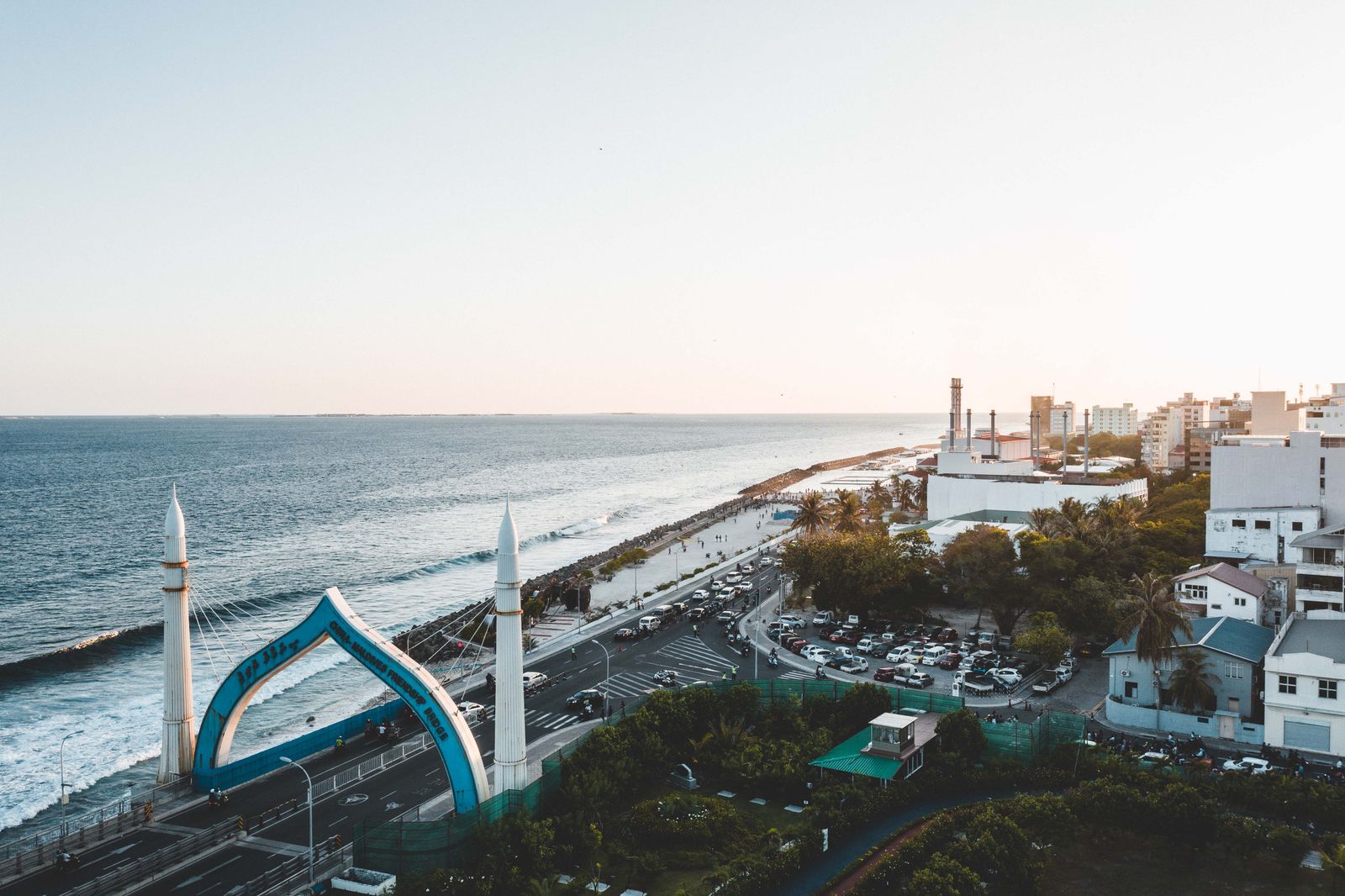
The morning tuna fish market at Male waterfront (local yellowfin tuna landed by traditional dhow fishermen), the Friday Mosque and the National Museum’s Maldivian cultural history.
Photo: Mark Fischer, CC BY-SA 2.0

Maafushi’s guesthouse culture: the alternative to resorts, staying with Maldivian families at 15% of the resort cost, with a bikini beach and reef accessible by rented bicycle.
Photo: U.S. Marine Corps photo by Sgt. Iyer Ramakrishna, Public domain

The only place in the world where tiger sharks are reliably encountered year-round by divers: a nutrient-rich deep water channel that attracts the largest gathering of tiger sharks in any ocean.
Photo: Asaymirus, CC BY-SA 4.0

A 7-10 day liveaboard on a traditional dhoni (wooden boat): 4 dives per day across multiple remote atolls, far from any resort, with hammock head sharks, schooling fish and healthy coral.
Photo: Philip Pankhurst , CC BY-SA 2.0

The southernmost atoll: a complex of islands connected by a causeway, WWII British air base ruins (now a dive site), and a reef environment distinct from the northern atolls.
Maldives (Wikipedia) →Photo: David Stanley from Nanaimo, Canada, CC BY 2.0
Shredded smoked tuna with coconut, onion and chilli, eaten with flatbread (roshi): the Maldivian national breakfast, eaten at every guesthouse and local island.
A clear tuna broth served with rice, lime, chilli and onion: the national soup of the Maldives, eaten with your fingers in the traditional way.
A deep-fried flatbread pastry filled with tuna and egg: the Maldivian version of a samosa, sold at every street stall in Male.
Sweet banana fritters made from local Maldivian bananas: a snack sold from roadside stalls on local islands.
Fresh-tapped palm toddy: the sweet juice of the date palm flower, tapped before dawn. Alcoholic (palmyra toddy) versions exist on local islands; resorts are alcohol-permitted.
A thick tuna paste of intense salinity and umami: the Maldivian condiment eaten with every meal in Dhivehi households.
All resorts are alcohol-licensed (the Maldives is Muslim; local islands are dry). The sunset cocktail from an overwater villa deck is the defining Maldivian beverage experience.
Strong Ceylon-style black tea, sweetened and drunk multiple times per day: the universal social beverage of local island communities.
Velána International (MLE) in Malé is the only international hub. Emirates, Qatar Airways, Sri Lankan, Singapore Airlines and several charter airlines serve MLE. Transfers to resort islands are by speedboat or seaplane. For trip planning, see the official Maldives tourism portal.
Emirates via Dubai and Qatar Airways via Doha are the two most frequent connections from Europe to Male, with typically one stop and total journey times of 11–13 hours.
Sri Lanka is the closest country to the Maldives (1h from Colombo) — combining a Maldives resort stay with Sri Lanka cultural exploration is one of the most natural two-country itineraries in the Indian Ocean.
Seaplanes only fly in daylight — resorts in outer atolls require a domestic flight + speedboat transfer if arriving on late evening international flights. Confirm transfer logistics with your resort before booking.
The public ferry network connects 200+ islands at MVR 20–50 per trip — infrequent (some routes run once per week) but extremely cheap. Speedboats from operators in Malé cover most inhabited islands daily at US$10–40.
November to April is the dry northeast monsoon — the best time for visibility (30m+), calm seas and the classic overwater bungalow experience. May to October brings the southwest monsoon with rougher seas and reduced visibility, but also manta ray aggregations (May–November) and whale shark aggregations year-round at South Ari Atoll.
📅 Maldives is in its best season in January, February, March, April, November, December. See where else is good to go in those months, or browse where to go by month.
The Maldives splits into two entirely different economies: the resort islands (extremely expensive, all-inclusive model) and the local inhabited islands (budget-friendly, alcohol-free, but accessible since 2009). The Maldivian Rufiyaa (MVR) is the local currency; USD is accepted everywhere at resorts.
Budget travel in the Maldives became possible in 2009 when the government permitted guesthouses on inhabited islands.
Mid-range resorts in the Maldives (Cinnamon, Sun Siyam, Vilamendhoo) offer the full overwater bungalow experience from US$300–600/night for a beach villa — house reef, dive centre, multiple restaurants, included breakfast.
Soneva Fushi (North Malé Atoll, overwater and beach villas from US$2,000/night, the first luxury barefoot resort, opened 1995) and Six Senses Laamu (the southernmost luxury resort) are the Maldives at its most considered.
Two nights in Malé, five nights at a resort atoll. The Maldives is an archipelago of 1,192 islands in 26 atolls across 900km of Indian Ocean — the flattest country on earth (average height 1.5m above sea level). A week here is really a week on one island.
Malé (4km², 130,000 people — the most densely populated capital city on earth at 32,000 people per km²) is nothing like the resort Maldives. The Old Friday Mosque (Hukuru Miskiy, 1656, the oldest mosque in the Maldives, built from coral stone with intricate Arabic calligraphy carved on every surface) and the National Museum (a former sultan’s palace with pre-Islamic artefacts including coral stone Buddha heads).
Malé sits 1.5m above sea level — the sea wall is literally the city’s perimeter. The Maldives will lose 80% of its land area if sea levels rise 1m, and the government purchased land in Sri Lanka and India as potential relocation sites in 2009 — the first government in history to plan for its own country’s disappearance.
The Male fish market (the tuna auctions at dawn — skipjack, yellowfin and bigeye tuna unloaded from dhoni fishing boats at 5am) is the genuine economic engine of Maldivian atolls, not tourism. Transfer by speedboat (30–90 min) or seaplane (15–45 min) to the resort island.
The seaplane transfer in the Maldives — a de Havilland DHC-6 Twin Otter or Cessna Caravan flying at 500m over the atolls — is arguably better than the destination. The view of the coral reef rings below, turquoise lagoons within dark blue ocean, is the aerial image of the Maldives that defines the country.
Every resort island has a “house reef” — a coral reef accessible directly from the beach or jetty, without a boat. The Maldives house reef experience (mask and fins from the beach, 20 minutes, Napoleon wrasse, reef sharks, turtles, parrotfish, moray eels) is one of the most straightforward snorkelling experiences on earth.
The Maldivian coral reefs experienced mass bleaching in 1998, 2010 and 2016 due to elevated sea temperatures. The 2016 event bleached approximately 60% of the shallow coral. Recovery has been partial; deeper reefs (15–30m) have significantly better coral cover than the shallow areas.
A two-dive day with the resort dive centre: a channel dive (the passes between atolls where strong currents create extraordinary concentrations of fish — grey reef sharks, eagle rays, hammerheads) and an overhang dive (the walls of coral dropping to 40m+ with sea fans, crinoids and anthias clouds).
The Maldives is rated among the top five dive destinations in the world for shark diversity — grey reef sharks, white-tip reef sharks, nurse sharks, hammerhead sharks (Rasdhoo Atoll), whale sharks and occasionally tiger sharks are all present in different atolls.
A sunrise trip to a private sandbank (a strip of white sand 50m long, temporarily above water, entirely empty) for breakfast at dawn. The dolphin sunset cruise (spinner dolphins in pods of 100–500 that bow-ride the dhoni in the channel at sunset) is the most reliable wildlife experience in the Maldives.
Spinner dolphins (Stenella longirostris) live year-round in the Maldives atolls — pods of 100–500 individuals move through the channels twice daily. The spinning leap (spinning on the long axis, the behaviour that gives them their name) is believed to remove parasites and communicate.
At South Ari Atoll and Baa Atoll (May–November) reef manta rays (Mobula alfredi, wingspan up to 5m) aggregate at cleaning stations — hovering stationary above a coral head while cleaner wrasse remove parasites. Snorkelling (not diving) over a cleaning station with 15–20 mantas directly below is one of the most striking marine wildlife experiences available.
The South Ari Marine Protected Area has the world’s largest known aggregation of whale sharks — resident year-round, concentrated around plankton-rich fishing dhoni areas. Snorkelling with a 10m whale shark is legal and managed in the Maldives; the sharks are entirely docile filter feeders.
A final morning snorkel on the house reef before speedboat or seaplane transfer back to Malé. Velána International Airport (MLE) for connections — most European flights depart in the evening, giving a full final day.
The Maldivian dhoni (the traditional wooden fishing and transport boat, with a diesel engine replacing the sail since the 1970s but the same hull form as for centuries) remains the primary transport between islands. The broad, high-sided hull design is perfectly adapted to the Indian Ocean swell.
Seaplanes only fly in daylight; late flights land at guesthouses in Male. Book at least 3 months ahead in peak season.
A full-board resort: USD 500-5,000/night. A local island guesthouse: USD 60-150/night.
Local islands and Male are alcohol-free. Resorts are licensed.
The speedboat transfers (1-3 hours) can be rough in the southwest monsoon. Take Dramamine if prone.
The local island culture is conservative and private. Respect modest dress in village areas.
On local islands, there is typically one designated bikini beach. Cover up in the village.
The Hanifaru Bay manta aggregation requires a permit and advance booking through your resort or operator.
Do not touch, stand on or collect coral anywhere in the Maldives. Heavy fines apply.
Quick answers to the questions people most often ask before visiting Maldives.
November to April is the dry northeast monsoon — the best time for visibility (30m+), calm seas and the classic overwater bungalow experience. May to October brings the southwest monsoon with rougher seas and reduced visibility, but also manta ray aggregations (May–November) and whale shark aggregations year-round at South Ari Atoll.
Velána International (MLE) in Malé is the only international hub. Emirates, Qatar Airways, Sri Lankan, Singapore Airlines and several charter airlines serve MLE. Transfers to resort islands are by speedboat or seaplane.
Expect roughly US$80–150 a day on a budget and US$400–700 mid-range, or US$1,500+ for a more luxurious trip, per person and excluding flights.
Maldives uses the MVR.
Plug types: Type G / C (UK three-pin and two-pin, 230V).
Book snorkelling tours, whale shark encounters, sunset dolphin cruises and dive experiences in the Maldives.
FreeFind guesthouses on local islands and budget accommodation beyond the luxury resort circuit.
FreeThe Maldives’ primary messaging platform — essential for contacting local guesthouses and boat operators.
FreeAvailable in Male and selected resort islands — limited coverage but useful on the main island.
FreeThe island capital, the island that made the Maldives affordable, and the atolls where mantas gather — five very different sides of the Maldives.
Maldives sits within easy reach of several other destinations — each with a completely different character.


