NP
Nepal
Roof of the world, home of Everest
Roof of the world, home of Everest

The classic 12-14 day trek: Lukla flight, the Khumbu Valley, Namche Bazaar, Tengboche Monastery and Base Camp at 5,364m with the Khumbu Icefall above. Acclimatisation is essential.

A 200km circuit around the Annapurna massif crossing the Thorong La Pass (5,416m): arguably the world’s greatest long-distance trek.

Boudhanath stupa (the largest in the world at 36m high, eyes painted on each face), Pashupatinath’s Hindu cremation ghats on the Bagmati River and the three Durbar Squares (Kathmandu, Patan, Bhaktapur).

A lake city at the foot of the Annapurna range: the Fishtail Mountain (Machhapuchhre, 6,993m) reflection in Phewa Lake at dawn, paragliding from Sarangkot and the base for the Annapurna Circuit.

A UNESCO National Park of terai jungle: one-horned rhinos (the world’s third-largest population), Bengal tigers, gharial crocodiles and elephant-back safaris.

The birthplace of Siddhartha Gautama (Buddha, 623 BC): the Sacred Garden’s Ashoka Pillar, the Maya Devi Temple and a grove of international Buddhist monasteries from 30 countries.
The finest medieval square in Nepal: 55-Window Palace, the Nyatapola Temple (five-tiered, the tallest in Nepal) and a pottery workshop culture that survived the 2015 earthquake.

The “Forbidden Kingdom”: a restricted-area desert valley of cliffside cave monasteries and Tibetan culture accessible only with a special permit.
A complete Nepali meal served twice daily: lentil soup (dal), rice (bhat), vegetable curry, pickles and papadum. Refills are unlimited. Trekkers eat two dal bhats per day; it is sufficient fuel.
Steamed or fried dumplings filled with buffalo meat, vegetables or cheese: Nepal’s most popular snack, eaten at every tea house on every trek.
A noodle broth soup with vegetables and meat: the Tibetan-influenced noodle soup of the high Himalayas, warming and sustaining at altitude.
A crispy ring-shaped fried bread made from rice flour and banana: traditionally made at Tihar (Diwali) and Dashain festivals.
Masala chai at lower altitudes; butter tea (po cha – brick tea, yak butter and salt) at altitude: the warming drink of Sherpa and Tamang culture.
A hot fermented millet beer drunk through a bamboo straw inserted into a pot of wet millet: the traditional drink of the Rai and Limbu peoples of eastern Nepal.
Stir-fried noodles (Nepali chow mein) and sekuwa (grilled meat skewers with local spices): Kathmandu street food standards.
A distilled grain alcohol (millet or rice) made in local homes throughout Nepal: very strong, very clear, and served warm at village festivals.
Kathmandu Tribhuvan (KTM) is the only international airport. Mountain airstrips (Lukla, Pokhara, Jomsom) operate domestic services via Yeti Airlines, Tara Air and Nepal Airlines. Overland crossing from India is possible at multiple border points. For trip planning, see the official Nepal tourism portal.
💡 Qatar Airways via Doha is generally the best-value and most convenient European routing to Kathmandu — good connections from UK regional airports. Turkish Airlines via Istanbul is also competitive.
💡 Delhi is the primary hub for Kathmandu — IndiGo operates multiple daily connections at budget prices, and the 1h30 flight is the obvious India–Nepal link.
💡 Lukla (2,860m) has one of the world’s most dramatic airport approaches — a 527m runway on a steep slope cut into the mountain face, visible 30 seconds before landing. The flight is the beginning of every Everest Base Camp trek.
💡 The Kathmandu–Pokhara tourist bus (NPR 600–1,000) is scenic but slow on mountain roads — the 40-minute domestic flight (NPR 3,000–5,000) is worth the premium for most itineraries.
October and November are the best months — post-monsoon clarity, stable weather, Everest Base Camp trail in perfect condition. March to May (spring) is second best: rhododendrons in bloom, slightly hazier but warm. The monsoon (June–September) makes trekking muddy and leechy but the Mustang and rain-shadow areas stay dry.
Nepal is one of the cheapest countries in Asia for daily expenses — guesthouses, local food and internal transport are all very affordable. The main costs are the trekking permits and the international flight.
Dal bhat — steamed rice with lentil soup, vegetable curry and pickles — is the Nepali national meal, costs NPR 300–500 and comes with free refills at most teahouses. It is also the ideal trekking fuel.
The Everest mountain flight at NPR 8,000–12,000 (≈US$60–90) is the most cost-efficient way to see the Himalayan peaks close-up without trekking. A once-in-a-lifetime 90 minutes.
A helicopter flight to Everest Base Camp (5,364m) and Kala Patthar viewpoint costs US$800–1,200pp on a shared basis — 3 hours, landing in the Khumbu, coffee at the highest coffee shop in the world.
Kathmandu for two days, Pokhara for one, the Annapurna foothills for two, a short Everest region flight to close. A week is enough to experience the culture and mountains without committing to a full high-altitude trek.
Kathmandu Durbar Square — the old royal palace complex, with the Kumari (the living goddess, a young girl chosen as the earthly manifestation of Taleju) still visible from her window. Pashupatinath temple on the Bagmati River — the holiest Hindu site in Nepal, with open-air cremations on the riverside ghats.
💡 Boudhanath Stupa — the largest stupa in South Asia and one of the largest in the world — is surrounded by Tibetan monasteries and feels nothing like the rest of Kathmandu. The evening kora (circumambulation) with hundreds of Tibetan pilgrims turning prayer wheels is one of the great atmospheric experiences in Asia.
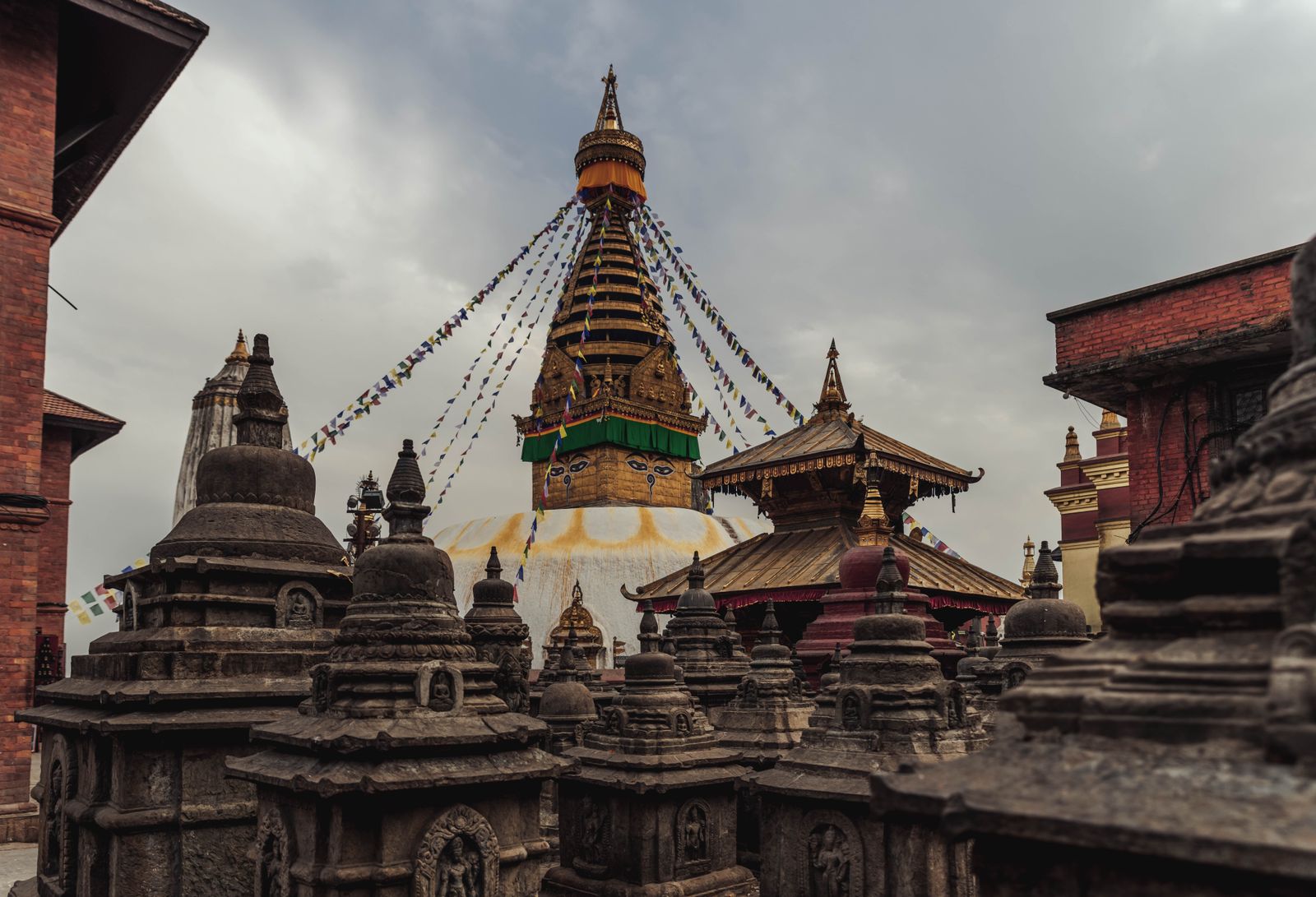
Bhaktapur — a medieval Newar city 13km east of Kathmandu, UNESCO World Heritage Site, largely intact after the 2015 earthquake — is quieter and better preserved than central Kathmandu. The 55-Window Palace. Swayambhunath (the Monkey Temple) — a stupa on a hill above the valley, the painted eyes of the Buddha watching every direction.
💡 Bhaktapur’s Dattatreya Square is the least-visited of the three Durbar Squares in the valley and arguably the most atmospheric — local life continues around the temple entirely without tourist management.
40-min flight from Kathmandu. Pokhara sits at 820m on the shore of Phewa Lake with the Annapurna massif (8,091m) rising directly behind it. The World Peace Pagoda on the ridge above. Sunset from the lakeside with Machhapuchhre (the Fishtail, unclimbed) lit gold.
💡 The reflection of the Annapurnas in Phewa Lake at dawn — before the wind comes up and breaks the surface — is one of the most reproduced images in Nepal. The Barahi Island temple in the middle of the lake can be reached by rowboat for NPR 200.
The Australian Camp trail from Kande (1h drive from Pokhara) rises through Gurung villages to a viewpoint at 2,100m with a 180-degree panorama of the Annapurna range. A genuine Himalayan trekking experience without the altitude risk or permit complexity of the full circuit.
💡 The Australian Camp (also called Pothana) is the finest half-day accessible viewpoint near Pokhara. The trail through Gurung villages — 3h up, 2h down — requires no special permit and no guide, though one adds context.
Ghandruk is a Gurung village at 1,940m — traditional stone houses, terraced fields, the Annapurna South face directly above. The ridge walk between Ghandruk and Landruk gives uninterrupted mountain views and passes through rhododendron forest (March–April) of extraordinary colour.
💡 Ghandruk has a Gurung Museum (NPR 100) documenting the Gurkha soldier tradition — Nepal’s most internationally known cultural export, and a source of deep national pride. The museum is surprisingly moving.
A 35-min mountain flight from Kathmandu over the Everest region gives close views of Everest (8,849m), Lhotse, Cho Oyu and the Khumbu glacier from aircraft altitude. Or fly to Lukla (the Everest Base Camp trek starting point) for a day hike to Namche Bazaar.
💡 The Everest mountain flight (Yeti Airlines, Tara Air: 1h30 from Kathmandu) flies wingtip-close to the Himalayan peaks at dawn. Every passenger gets a window seat on the mountain side. NPR 8,000–12,000. Departs 6:30–7am only.
Return to Kathmandu. Thamel — the tourist district — for final purchases: genuine cashmere (check the hand-feel), pashmina, Thangka paintings, singing bowls. Tribhuvan Airport (KTM) for international flights.
💡 Real cashmere in Thamel costs NPR 3,000–8,000 for a shawl — the soft fibres from the underbelly of the Changthangi goat. Rub it gently on your wrist: real cashmere feels warm and soft immediately. Acrylic blends feel cool and slightly scratchy.
Above 3,000m, ascend no more than 300-500m per day. Rest days at Namche (3,440m) and Dingboche (4,410m) are mandatory.
The Tenzing-Hillary Airport at Lukla has a 527m runway on a slope. Book through Nepal Airlines or Tara Air; book well in advance.
A dal bhat: NPR 300-500 (EUR 2-4). Trek tea house accommodation: USD 5-15/night.
Palms together at chest height, slight bow. Used as hello, goodbye and thank you.
The Trekkers’ Information Management System (TIMS) card and the Sagarmatha National Park entry permit are required for Everest Base Camp. Buy at Kathmandu’s Nepal Tourism Board.
A licensed guide is mandatory for restricted areas (Upper Mustang) and highly recommended for all major treks.
The warmth and resilience of Nepali culture, especially after the 2015 earthquake, makes every visitor feel genuinely welcomed.
The October-November and March-May windows are when mountain visibility is highest.
Nepal’s most popular ride-hailing and bike-taxi app — dominant in Kathmandu for affordable city transport.
FreeAvailable in Kathmandu — limited coverage but reliable for airport and hotel transfers.
FreeBook Everest Base Camp treks, Chitwan safari, Pokhara paragliding and Nepalese tours.
FreeNepal’s primary messaging platform — essential for contacting trekking agencies, guides and guesthouses.
FreeDownload offline topographic maps of Nepal’s trekking routes — essential when there is no cell signal.
FreeBook hotels and teahouses in Kathmandu, Pokhara and trekking departure points.
FreeFrom Kathmandu’s ancient temples to the Annapurna views of Pokhara, the wildlife of Chitwan, and the sacred birthplace of the Buddha at Lumbini.
Nepal sits within easy reach of several other destinations — each with a completely different character.


