BG
Bulgaria
Rose valleys, ancient Thrace and Black Sea beaches
Rose valleys, ancient Thrace and Black Sea beaches

A 10th-century monastery in a mountain valley, rebuilt in the 19th century: the courtyard’s striped arches and the Church of the Nativity’s floor-to-ceiling exterior frescoes are the finest of Bulgarian National Revival art.

Three hills of National Revival wooden houses above a 2nd-century Roman theatre: the Kapana creative district’s street art and the ancient city of Plovdiv (continuously inhabited for 8,000 years).

The Tsarevets fortress on a loop of the Yantra River: the seat of the Second Bulgarian Empire (1185-1393), with a sound-and-light show projected onto the ruins at night.

Red sandstone pillars up to 200m tall, with a medieval fortress built into the rocks: the most dramatic geological landscape in Bulgaria.

The Rose Festival (end of May – first week of June): dawn harvesting of Rosa damascena in pink fields, and the rose oil distilleries that produce 85% of the world’s attar of roses.

Nessebar: a UNESCO old city on a peninsula with 40+ medieval churches. Sozopol: an old town of wooden houses on a Black Sea cape — less developed and more atmospheric.

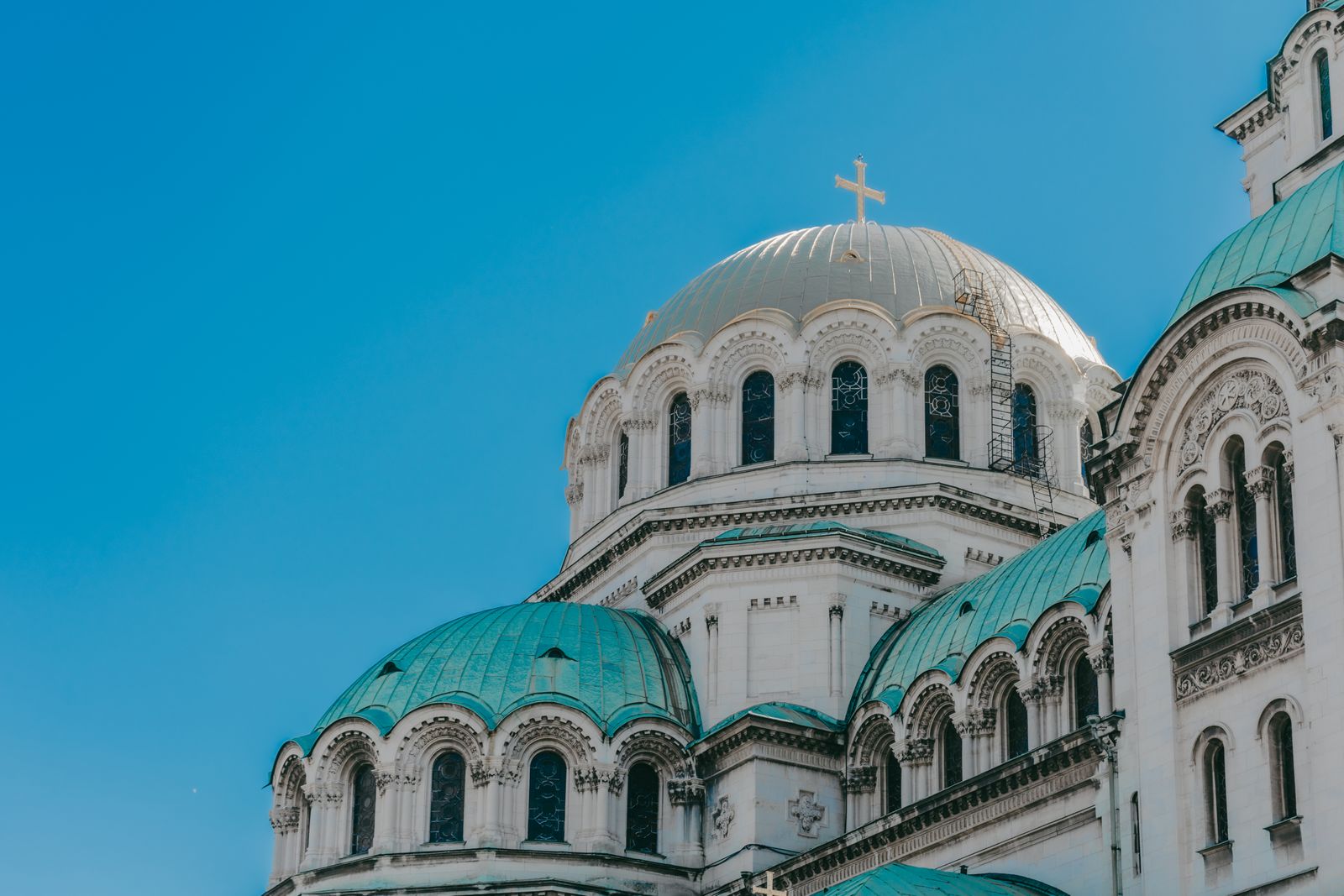
The gold-domed Alexander Nevsky Cathedral (1912, one of the largest Orthodox cathedrals in the world), the ancient Serdica ruins under the Sofia metro and the National History Museum.

The best ski resort in southeastern Europe, with the most reliable snow in Bulgaria: and Bansko’s old town of stone houses and churches.
Filo pastry layers filled with white cheese (sirene) and egg: eaten for breakfast with ayran (yogurt drink) or boza (a fermented millet drink). The most universally eaten Bulgarian pastry.
Chopped tomatoes, cucumbers, roasted pepper, onion and feta-style sirene: Bulgaria’s national salad, eaten as a starter at every Bulgarian meal.
The Bulgarian version uses potatoes (not aubergine), minced pork with cumin and paprika, and a yogurt-egg topping: denser and more aromatic than the Greek version.
Cold cucumber and yogurt soup with garlic, dill and walnuts: the Bulgarian summer starter, drunk from a glass at roadside stalls.
Mavrud (a thick, deeply coloured indigenous red from Plovdiv) and Melnik wine (from the narrow-leafed Shiroka Melnishka Loza variety) are Bulgaria’s finest.
Bulgarian rakia: 40-60% alcohol, drunk at every Bulgarian gathering. Grappa’s Balkan cousin.
The two national lagers: cold and correct at a mehana (traditional tavern).
Bulgaria’s most famous food export: Lactobacillus bulgaricus (only found in Bulgarian yogurt) produces a uniquely thick, sour texture.
Sofia (SOF) is the main hub; Plovdiv (PDV) and Varna (VAR) have some direct European connections. Bulgaria Air is the national carrier; Ryanair and Wizz Air serve Sofia extensively. For trip planning, see the Bulgaria Travel portal.
💡 Wizz Air’s Budapest and Sofia routes from the UK are among the cheapest in Eastern Europe — fares under £50 one-way are common with advance booking.
💡 Bulgaria connects well to neighbouring countries — Plovdiv is 1h30 from Thessaloniki by road, and Sofia is 5h from Belgrade.
💡 The Sofia Airport Metro (Line 2) runs from Terminal 2 directly to Sofia’s city centre in 30 minutes for BGN 1.60 — the cheapest airport transfer in the EU.
💡 Bulgaria’s road network has improved significantly since EU accession — the Trakia Motorway (Sofia–Plovdiv–Burgas) is fast and well-maintained. A vignette sticker (BGN 15/week) is required on motorways.
May to September is the sweet spot — warm Plovdiv summers, the Black Sea coast at its best in July–August, hiking in the Rhodope and Rila mountains from June. December to March brings snow in the mountains and good ski conditions at Bansko and Borovets.
Bulgaria is one of the cheapest countries in the EU — significantly cheaper than its Balkan neighbours Croatia and Slovenia, with excellent wine, food and mountain scenery at budget prices.
Shopska salad — tomatoes, cucumbers, peppers, onion and grated white cheese (sirene) — is the Bulgarian national starter and costs BGN 5–8. The white cheese is saltier and drier than Greek feta and entirely different.
Bulgarian wine from Melnik (in the south-west, the narrowest town in Bulgaria at just 60m wide) — the Shiroka Melnishka Loza grape variety, found nowhere else — is the most distinctive and interesting in the country.
The Grand Hotel Plovdiv and Sofia Hotel Balkan (a Marriott Luxury Collection property in the former Balkan hotel building) are Bulgaria’s finest addresses — at BGN 300–700/night, exceptional value by Western European standards.
Sofia for two days, Plovdiv for two, the Rhodope mountains for one, the Rila Monastery and Bansko to close. Bulgaria’s highlights are clustered within 3 hours of each other.
The Alexander Nevsky Cathedral (1912, gold domes, one of the largest Eastern Orthodox cathedrals in the world) dominates central Sofia. Beneath the city: the Serdica archaeological complex — Roman streets, a basilica and thousands of artefacts from the 4th-century Roman city visible through glass floors of the Serdica Metro station.
💡 The Serdica station on Sofia Metro Line 1 is built around — and through — the Roman city. Take the metro one stop just to see the excavations beneath the glass platforms. Entry to the metro costs 1.60 BGN.
Vitosha mountain rises to 2,290m directly behind Sofia — reachable by metro and cable car in 40 minutes from the city centre. The National History Museum (25km from centre, worth the taxi): Bulgaria’s most comprehensive collection from Thracian gold to communist-era photographs.
💡 The Thracian gold collection at the National History Museum — the Panagyurishte treasure (rhyton cups from 400 BCE in the shape of animals, exquisite goldsmithing) and the Valchitran treasure — is one of the finest collections of ancient metalwork in Europe.
1h30 from Sofia. Plovdiv (European Capital of Culture 2019) is Bulgaria’s second city and arguably its most beautiful — an Old Town of colourful National Revival houses on three hills above a Roman theatre still used for concerts. The Kapana Creative District for galleries and cafes.
💡 Plovdiv’s Roman amphitheatre (2nd century CE, 7,000 seats, discovered accidentally during a 1972 landslide) is used for concerts in summer. Sitting in the stone seats with the Old Town behind and the mountains ahead is the finest setting for live music in Bulgaria.
The Old Town’s National Revival architecture — houses from the 18th–19th century Bulgarian bourgeoisie, projecting upper floors, painted facades and hidden courtyards — is among the most distinctive in the Balkans. The Ethnographic Museum in the Kuyumdzhioglu house and the Georgiadi house for the finest interiors.
💡 Plovdiv is claimed to be Europe’s oldest continuously inhabited city — evidence of settlement from 6000 BCE. The current Old Town buildings are “only” 200–300 years old, but the site beneath them has 8,000 years of history.
1h30 from Plovdiv. The Rhodope mountains — forested ridges, traditional villages and the Bachkovo Monastery (11th century, second largest in Bulgaria, frescoes from the 17th century) — are the most accessible mountain region from Plovdiv. The Trigrad Gorge and Devil’s Throat cave.
💡 The Devil’s Throat cave (Dyavolskoto Garlo) is a 42m waterfall disappearing underground into a cave system — the water is not found again for 3km, its route still unknown. The cave is at 1,455m and genuinely spectacular.
2h from Plovdiv. The Rila Monastery (founded 927 CE, rebuilt 1833–1837, UNESCO World Heritage Site) is the spiritual heart of Bulgaria — striped arches, vivid murals covering every surface of the courtyard facades, and the Hrelyo Tower above. Ivan Rilski’s relics inside the main church.
💡 The Rila Monastery is at 1,147m in a valley surrounded by peaks reaching 2,900m. The interior of the main church (Nativity Church) has murals on every surface — 1,200 wall paintings from the 1840s, covering Biblical scenes and the Last Judgement on the outer narthex.
1h from Rila. Bansko is Bulgaria’s main ski resort (1,100–2,600m, 75km of pistes, Gondola lift) and in summer a base for Pirin National Park hiking. The old town has preserved National Revival houses and mehanas (traditional taverns) serving some of the best Bulgarian food.
💡 Bansko ski passes cost €25–40 per day — roughly one third of comparable Austrian or French resort prices. The snow quality (600m vertical) is respectable from January to March and the mountain has improved significantly since EU infrastructure investment.
Both work in Sofia and Plovdiv.
A banitsa: BGN 1.50 (EUR 0.75). A restaurant meal: BGN 10-20 (EUR 5-10). Sofia hotel: EUR 40-80.
The directness can seem blunt; the helpfulness is genuine.
Sofia to Plovdiv: 2h by train. Sofia to Varna: 7h or 1h by plane.
Russian Cyrillic knowledge helps; street signs are often in both scripts.
Both give good 4G coverage.
Like Albania, Bulgarians nod for no and shake for yes. Very confusing initially.
Thank you in Bulgarian: always appreciated.
The dominant ride-hailing app in Sofia, Plovdiv and Varna — far cheaper than licensed taxis.
FreeBulgaria’s national rail app — book intercity tickets between Sofia, Plovdiv and the coast.
FreeBook Rila Monastery day trips, Sofia city tours, Plovdiv Old Town walks and Bulgarian experiences.
FreeBudget intercity buses across Bulgaria and to Istanbul, Bucharest and Thessaloniki.
FreeTrack BGN (Bulgarian Lev) rates — Bulgaria uses the Lev not the Euro despite EU membership.
FreeA 7,000-year-old capital, one of Europe’s oldest cities, a medieval gorge-town, a mountain resort and an ancient sea-peninsula — five sides of Bulgaria.
Bulgaria sits within easy reach of several other destinations — each with a completely different character.


