UZ
Uzbekistan
Silk Road cities of turquoise and gold
Silk Road cities of turquoise and gold

Three madrasas (Ulugh Beg 1420, Sher-Dor 1636, Tilla-Kari 1660) enclosing a central square: the most photographed architectural ensemble in Central Asia, tiled in cobalt blue and gold.
Photo: Gustavo Jeronimo from Aranjuez, Spain, CC BY 2.0

The Kalon Minaret (47m, 1127 AD): the only Bukhara structure Genghis Khan refused to demolish in 1220. The surrounding UNESCO old city of 140 listed monuments in a 2.5km radius.
Photo: Petar Milošević, CC BY-SA 4.0

The best-preserved medieval Islamic city in Central Asia: entirely enclosed within 2,200m of mud-brick walls, with 50 intact monuments including the Islam Khodja Minaret and the Kuhna Ark.
Photo: Aziza Alimova, CC BY-SA 4.0

UNESCO: the birthplace of Timur (Tamerlane), with the ruins of his Ak-Saray Palace (white palace) whose entrance arch (22m wide) once towered over 50m high.
Photo: Jean-Pierre Dalbéra from Paris, France, CC BY 2.0

The Soviet-era Tashkent Metro: stations with marble columns and mosaics celebrating Uzbek history. The Chorsu Bazaar: a 16th-century domed market still in daily use.
Photo: Tim Adams, CC BY 4.0

The origin of Silk Road silk: the Yodgorlik Factory in Margilan where ikat silk is woven on wooden looms using a technique unchanged for 2,000 years.
Photo: Petar Milošević, CC BY-SA 4.0

A large lake in the Kyzylkum Desert: camel trekking, yurt camps and a night sky with no light pollution over hundreds of kilometres.
Photo: Carpodacus, CC BY-SA 4.0

7th-century Sogdian palace frescoes: discovered beneath old Samarkand, showing ambassadors from Byzantium, China and India visiting the Sogdian king.
Photo: Jona Lendering, CC0
Rice fried in cottonseed oil with lamb, carrots and onion, cooked in a kazan (cast-iron cauldron) over fire: the national dish of Uzbekistan. Samarkand plov and Fergana plov are different schools.
Baked triangular pastries filled with minced lamb, onion and cumin: sold fresh from tandoor ovens at every bazaar. The Uzbek version of the samosa.
Hand-pulled noodles in a lamb and vegetable broth: Central Asia’s noodle tradition, influenced by the Uyghur community of Xinjiang.
Lamb skewers grilled over charcoal: eaten at every chaikhana (teahouse) and bazaar.
Drunk from a piala (small bowl) at every chaikhana throughout the day: the social institution of Uzbek male life.
Soviet-era Uzbek cognac and home-distilled mulberry vodka: offered at every Uzbek family table.
The most widely available Uzbek lager.
A round flatbread stamped with a chekich (bread stamp) and baked in a clay tandoor: carried under the arm across every Uzbek city.
Tashkent Islam Karimov International (TAS) is the main hub. Uzbekistan Airways serves European routes. The Afrosiyob high-speed train connects Tashkent–Samarkand–Bukhara — the backbone of the Silk Road circuit. For trip planning, see the official Uzbekistan tourism portal.
Uzbekistan Airways operates direct flights from London, Frankfurt and several European cities to Tashkent. Turkish Airlines via Istanbul is a convenient alternative with high frequency.
The Afrosiyob high-speed train is the backbone of the Silk Road circuit — comfortable, reliable, scenic and cheap. Book tickets at railway.uz or through a local agent; the system accepts international cards intermittently.
The Yandex Go app (download before arrival) is the reliable ride-hailing option across all Uzbek cities — set destination in English, pay in cash or card, and avoid negotiating with street taxis.
Flying Bukhara–Urgench is faster but the 5-hour desert drive is one of Central Asia’s great road experiences — flat steppe turning to saxaul scrub, occasional camel herds, the Amu Darya River crossing at Khiva’s edge.
March to May and September to November are ideal — Samarkand, Bukhara and Khiva at comfortable temperatures (18–28°C), the Silk Road monuments at their most atmospheric. June to August is very hot (35–40°C) in the cities. December to February is cold but Tashkent has a lively indoor culture.
📅 Uzbekistan is in its best season in April, May, June. See where else is good to go in those months, or browse where to go by month.
Uzbekistan is excellent value — one of the cheapest Silk Road destinations, with good guesthouses, excellent food and low entrance fees. The Uzbekistani Som (UZS) has many zeros; prices in USD are widely used at tourist sites.
Plov (Uzbek pilaf — lamb, rice, carrots and chickpeas cooked together in a kazan cauldron, the national dish, cooked on Fridays for family gatherings and served from plov houses across the country) costs US$1–3.
Samarkand wine (produced in the Zarafshan valley since antiquity, the Timurid-era vineyard tradition) is experiencing a revival.
The Silk Road Samarkand (a new 5-star resort built around a reconstructed Silk Road caravanserai) and the Malika hotels in Khiva are Uzbekistan’s finest addresses.
Tashkent for one day, Samarkand for two, Bukhara for two, Khiva for two. The Uzbekistan Silk Road circuit is one of the great overland journeys in Asia — from the Timurid tilework of Samarkand to the mud-brick walls of Khiva, the density of medieval Islamic architecture is impressive.
Tashkent (2.5 million, the largest city in Central Asia) was almost entirely rebuilt after a devastating earthquake in 1966, giving it a distinctly Soviet character — wide boulevards, monumental buildings, metro stations that are genuine works of art (Kosmonavtlar station: space-themed mosaics and cosmonaut busts from 1977). The Chorsu Bazaar for the full sensory arrival into Uzbekistan.
The Tashkent Metro (1977) was one of the most ornate in the Soviet Union — each station designed by different architects with different themes. Kosmonavtlar (Cosmonauts) station has portraits of Yuri Gagarin and Valentina Tereshkova in mosaic. Photography was prohibited until 2018.
3h30 by high-speed Afrosiyob train from Tashkent. Samarkand — the capital of Timur’s (Tamerlane’s) empire in the 14th–15th century, the midpoint of the Silk Road for 2,000 years — has the finest concentration of medieval Islamic architecture in the world. The Registan (three madrasas facing a central square, each covered in lapis and turquoise tilework) at sunrise, before the tourist buses arrive.
The Registan complex is UNESCO World Heritage and the most recognisable image in Central Asia — three 15th–17th century madrasas (Ulugbek, Sher-Dor, Tilla-Kari) arranged around a central plaza, their facades covered in geometric tilework. The Tilla-Kari (gilded mosque interior, entirely covered in gold) is the most overwhelming interior.
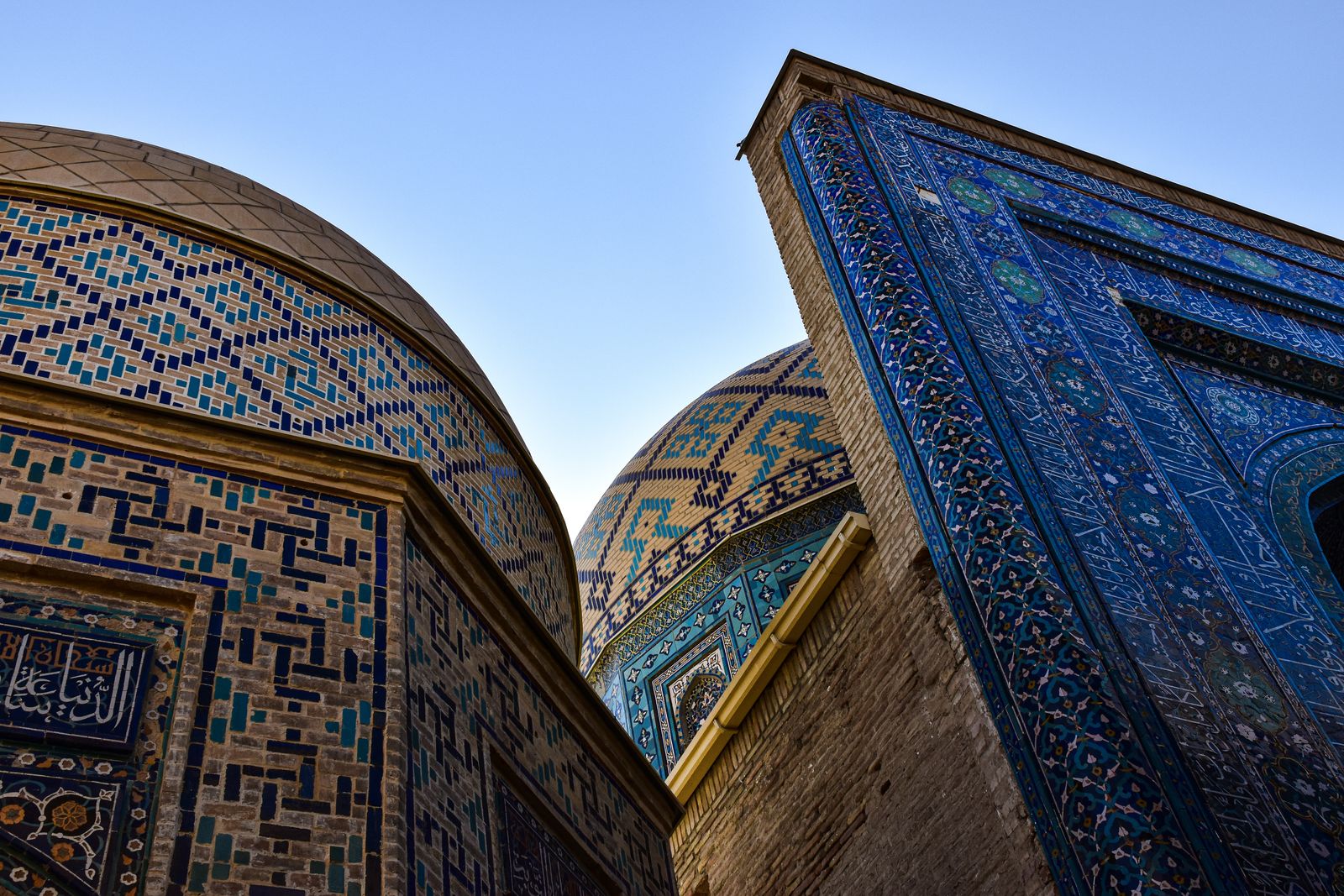
Gur-e-Amir (Timur’s mausoleum, 1404, a ribbed Persian dome on a drum covered in lapis-glazed tiles, the architectural prototype for the Taj Mahal) — Timur and his dynasty lie beneath an octagonal chamber under the largest onyx slab in the world. Shah-i-Zinda (the Avenue of Mausoleums) — 11 consecutive mausoleums from the 14th–15th century, the most intact medieval funerary complex in Central Asia.
Timur’s sarcophagus at Gur-e-Amir has a carved inscription: “Whoso disturbs my tomb will unleash an invader more terrible than I.” Soviet archaeologist Mikhail Gerasimov opened the tomb on 21 June 1941. Germany invaded the USSR the following day. This is coincidence, but an extraordinary one.
2h from Samarkand by train. Bukhara is the best-preserved medieval city in Central Asia — the 9th-century Ismail Samani Mausoleum (the oldest intact Islamic building in Central Asia), the Kalon Minaret (1127, 47m, the minaret from which criminals were thrown — the only structure in Bukhara that Genghis Khan ordered preserved after his 1220 destruction of the city).
Genghis Khan destroyed every city in Central Asia in his 1219–1221 campaign — Samarkand, Bukhara, Merv, Urgench — killing millions and ending the Islamic Golden Age in Central Asia. When he saw the Kalon Minaret of Bukhara (1127), he is said to have dropped his hat in admiration and ordered it spared.
The Ark of Bukhara (a massive fortress-citadel occupied continuously since the 5th century, residence of the emirs until 1920) and the three trading domes of Bukhara (16th-century covered bazaars still in use, one for money changers, one for hat makers, one for jewellers) for the most intact Silk Road bazaar experience in Central Asia.
The last Emir of Bukhara fled in 1920 when the Red Army (under Mikhail Frunze) besieged the city. He escaped on horseback to Afghanistan. The Ark fortress — where he had recently executed British agents Frederick Bailey and Charles Stoddart — was stormed and the city bombed from aircraft for the first time in Central Asian history.
5h drive across the Kyzylkum Desert (or fly 1h from Bukhara). Khiva — the Ichan Kala (inner walled city, UNESCO World Heritage Site, the most intact medieval Islamic city in the world) is a maze of 14th–19th century mosques, madrasas and minarets within a 2.5km mud-brick wall.
Khiva’s Ichan Kala is the most complete medieval Islamic urban environment anywhere — a city within a city, with the Juma Mosque (Friday Mosque, 212 carved wooden columns, each one different, the oldest from the 10th century) as its centrepiece. Unlike Samarkand and Bukhara, Khiva was never destroyed by the Mongols.
The Kalta Minor (the “Short Minaret” — the unfinished minaret begun in 1852 by Muhammad Amin Khan, intended to be the tallest in Central Asia at 70m, left at 26m when the Khan died in battle in 1855) and the Islam Khoja Minaret (the tallest in Uzbekistan at 57m, 1910) for the panoramic view of the mud-brick city. Fly from Urgench Airport (UGC) to Tashkent.
The contrast of Khiva with Samarkand is the essence of the Uzbekistan Silk Road circuit: Samarkand is magnificent and restored; Khiva is dusty, incomplete and medieval. The Kalta Minor’s unfinished top (the Khan died before it was complete) is more honest than any finished monument.
Tashkent to Samarkand: 2h10. Samarkand to Bukhara: 1h30. The most comfortable way to travel the Silk Road.
A plov portion: UZS 25,000-50,000 (EUR 2-4). A hotel in Bukhara: USD 30-80.
Being invited to share plov or tea is a deeply sincere gesture.
From Samarkand to Shakhrisabz or Khiva: shared taxi is the standard.
Both give reasonable 4G coverage in cities and tourist sites.
Thank you and hello in Uzbek: always appreciated.
The square before 8am, lit by the morning sun, with no crowds.
The region sees relatively few Western tourists; warmth and curiosity are genuine.
Quick answers to the questions people most often ask before visiting Uzbekistan.
March to May and September to November are ideal — Samarkand, Bukhara and Khiva at comfortable temperatures (18–28°C), the Silk Road monuments at their most atmospheric. June to August is very hot (35–40°C) in the cities.
Tashkent Islam Karimov International (TAS) is the main hub. Uzbekistan Airways serves European routes. The Afrosiyob high-speed train connects Tashkent–Samarkand–Bukhara — the backbone of the Silk Road circuit.
Expect roughly US$30–55 a day on a budget and US$80–140 mid-range, or US$250+ for a more luxurious trip, per person and excluding flights.
Uzbekistan uses the UZS.
Plug types: Type C / F (two-pin, 220V).
The dominant ride-hailing app in Tashkent and Samarkand — set up and verify your account before arriving.
FreeBook Samarkand Registan tours, Bukhara Silk Road walks, Khiva Old City entry and Uzbek experiences.
FreeUzbekistan’s dominant messaging platform — most local businesses and tour operators communicate via Telegram.
FreeBook hotels and boutique B&Bs in Samarkand, Bukhara, Khiva and Tashkent.
FreeTrack UZS (Uzbekistani Som) rates — amounts in the millions are normal; this app prevents confusion.
FreeThe metro-palace capital and the great Silk Road cities of the Registan, the trading domes, the walled desert town and the silk-and-ceramics valley — five sides of Uzbekistan.
Uzbekistan sits within easy reach of several other destinations — each with a completely different character.


