LV
Latvia
Art Nouveau capital, medieval Hanseatic city & Baltic amber
Art Nouveau capital, medieval Hanseatic city & Baltic amber
Latvia is the Baltic state with the finest city — Riga, the capital, is a UNESCO World Heritage Site with the largest collection of Art Nouveau buildings in the world, a 13th-century old town of great completeness and a cultural and gastronomic scene that has made it one of Northern Europe’s most dynamic capitals. Over a third of the city was designed in the Jugendstil (Art Nouveau) style between 1899 and 1913, producing a townscape of ornate facades, sculptural decoration and allegorical figures unlike anything else in Europe. Beyond Riga, the Gauja National Park contains medieval castle ruins in a river valley of great beauty; the Cape Kolka headland at the meeting of the Baltic Sea and the Gulf of Riga is elemental and dramatic; and the old seaside resort of Jūrmala has a fin-de-siècle wooden villa character all its own.
The Alberta iela and Elizabetes iela streets in Riga’s Quiet Centre form the world’s most concentrated collection of Art Nouveau architecture — over 800 buildings in a neighbourhood of decorative imagination. The Riga Art Nouveau Museum in one of these buildings recreates the apartment of a wealthy early 20th-century Latvian family. Architect Mikhail Eisenstein (father of the filmmaker Sergei) designed many of the most extravagant facades.
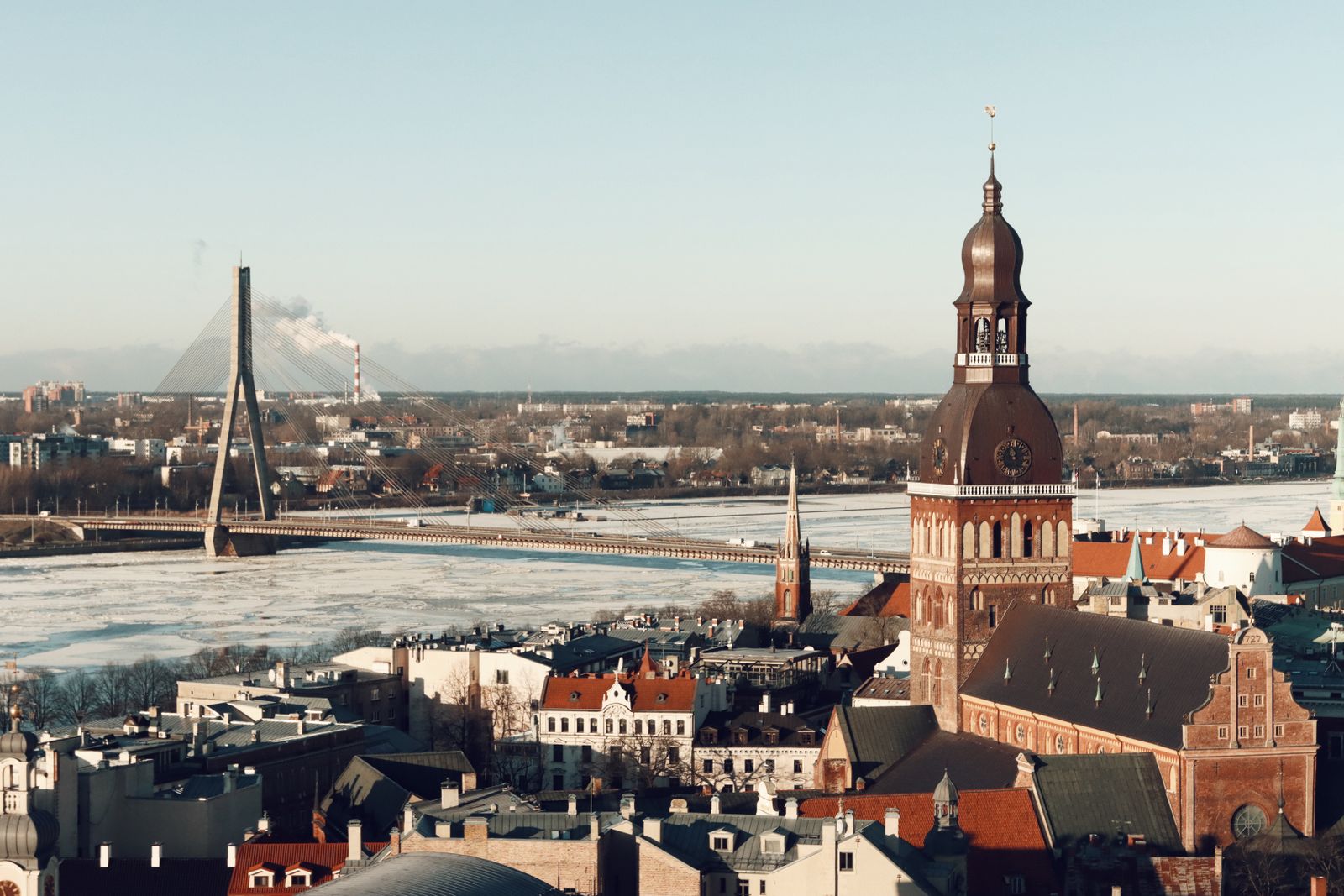
A UNESCO-listed medieval city of Gothic and Baroque architecture centred on the Dome Cathedral (the largest medieval church in the Baltic states, with one of Europe’s greatest pipe organs), the Art Nouveau-era Central Market (housed in five former zeppelin hangars) and the 13th-century walls and towers of the Hanseatic trading city. The Latvian National Museum of Art and the Black Heads House (rebuilt after Soviet demolition) are the highlights.
Latvia’s oldest national park follows the Gauja River valley through pine and deciduous forest, past the red sandstone cliffs and cave formations of Sietiniõas and the medieval castle ruins of Cēsis (one of the finest in the Baltic). Activities include canoeing, hiking, bobsled track (in winter) and exploring the valley’s rock and cave formations.
At the tip of the Kurzeme Peninsula, Cape Kolka marks the dramatic meeting of the Baltic Sea and Gulf of Riga in a landscape of eroded coastline, shipwreck remains and the eerie Slitere lighthouse. The Latvian coast between Liepaja and Kolka has Baltic amber washing ashore after storms and vast pine-backed beaches of wild beauty.
Pelēkie zirņi ar speķi — grey peas with fried bacon and onion, a traditional Christmas and festive dish.
Dark rye bread (rupjmaize) is the staple, eaten with almost every meal.
Lampreys caught in autumn, mainly on the Salaca and Daugava rivers, then grilled or smoked — a Latvian speciality sold at markets.
Smoked Baltic fish and wild mushrooms from the forests are seasonal treats.
A bitter herbal liqueur in a black ceramic bottle, based on a 1752 recipe — often mixed with blackcurrant juice.
Riga International (RIX) is the largest airport in the Baltic states. airBaltic is the national carrier with a wide European network. Lux Express coaches connect Riga to Tallinn and Vilnius. For trip planning, see the official Latvia tourism portal.
airBaltic has built Riga into the most connected Baltic hub — the carrier’s all-A220 fleet operates direct to 80+ European cities. Ryanair and Wizz Air add significant budget capacity from the UK.
The Lux Express Baltic circuit (Tallinn–Riga–Vilnius) connects three capitals in one comfortable coach service — reclining seats, WiFi, free coffee. One of Europe’s finest budget multi-city routes.
Riga bus 22 runs every 10–15 minutes from RIX to the city centre for €1.15 — buy from the driver or via the Rigo app. Journey time 30 minutes to Old Town.
Car hire in Riga (€25–50/day from RIX) is the best way to reach Jūrmala, Gauja, Rundale and Cape Kolka. The A-roads are fast and well-maintained; secondary roads are rougher but passable in a standard car.
May to September is the best window — Riga warm and busy, the Latvian coast and Gauja National Park accessible. June brings Jāņi (Midsummer) — the most important festival in Latvia, celebrated with bonfires, garlands and caraway cheese. December has one of Europe’s oldest Christmas markets.
📅 Latvia is in its best season in May, June, July, August, September. See where else is good to go in those months, or browse where to go by month.
Latvia is mid-range EU — comparable to Estonia and Lithuania, with excellent rye bread, the most Art Nouveau architecture in the world, and a Baltic coast that stays wild.
Lido — the Latvian self-service canteen chain (the flagship is a 2,000-seat log-cabin complex on Krasta iela) — serves Latvian home cooking at good value: grey peas with bacon, smoked ribs, rye bread and local beer.
Riga Black Balsam — a 45% herbal liqueur with 24 plant extracts produced in Riga since 1752 — is Latvia’s most distinctive drink.
The Grand Palace Hotel Riga and the Neiburgs Hotel (a renovated 1914 Art Nouveau building in the Old Town) are Riga’s finest addresses — from €160–400/night, with the Art Nouveau streetscape directly outside.
Riga for three days, Jūrmala for one, Gauja National Park for one, Rundale Palace for one, Cape Kolka for one. Latvia has the finest Art Nouveau architecture in Europe and a coast that barely changes from the 13th century.
Riga has more Art Nouveau buildings than any other city in the world — approximately 800, concentrated in Alberta iela and Elizabetes iela, designed mostly 1896–1913 by Mikhail Eisenstein (father of filmmaker Sergei). The Riga Old Town (UNESCO World Heritage Site) for the evening.
Mikhail Eisenstein designed 18 Art Nouveau apartment buildings in Riga. The building at Alberta iela 13 has screaming human faces and sphinxes at the 4th floor. They are still lived-in residential apartments; many residents will show visitors the staircases.
The Riga Central Market (five WWI zeppelin hangars converted to market halls in 1930, the largest market in Europe by area, UNESCO World Heritage Site) for smoked fish, rye bread in 40 varieties and Baltic dairy. The Latvian National Museum of Art for the finest collection of Latvian painting.
The zeppelin hangars were built at Vainode Airfield in 1915–17 to shelter German Navy Zeppelins. Dismantled after WWI, they were transported to Riga and re-erected as market halls — each one 240m long. The five halls have operated continuously since 1930.
The Freedom Monument (1935, “Māra” holding three golden stars, 42m column — maintained through Soviet occupation by unofficial honour guards who placed flowers daily despite prohibition). The Occupation Museum (Latvia’s 50-year Soviet occupation documented through personal testimony and objects). The evening in the Riga street food market.
The Latvian Singing Revolution (1987–1991) culminated in the Baltic Way — 2 million people forming a 675km human chain from Tallinn to Vilnius on 23 August 1989, the 50th anniversary of the Molotov-Ribbentrop Pact. It is the largest human chain ever formed and a pivotal moment in the Soviet dissolution.
25km from Riga. Jūrmala — 33km of white sand backed by pine forest, with Art Nouveau and eclectic wooden villas from the late 19th century built as summer residences for St Petersburg’s elite. The beach at Majori for the long, flat Baltic waves and the pine-scented air.
Jūrmala’s wooden villas were built by Russian and Baltic German merchants from the 1880s. Walking the Jomas pedestrian street is a catalogue of wooden Art Nouveau architecture — carved porches, painted facades, turrets — in a resort town that has retained its pre-war character.
1h from Riga. Gauja National Park — the Gauja River valley cut through red Devonian sandstone cliffs (20–40m), the Turaida Castle (13th century Livonian Order brick tower, Latvia’s most visited historical site) and Gutmanis Cave (the largest cave in the Baltic states, 500 years of visitor inscriptions on its walls).
Gutmanis Cave in Sigulda has inscriptions from 1521 — 500 years of visitors carving names layered above each other. The oldest are in Latin; Swedish, Russian, German and Latvian follow chronologically. The cave is 18.8m deep, 12m wide and entirely open — no admission fee.
1h30 south of Riga. Rundale Palace (1740, designed by Bartolomeo Rastrelli — architect of the Winter Palace in St Petersburg — for Biron, Duke of Courland) is the finest Baroque and Rococo palace in the Baltic states. The formal gardens were fully restored after the Soviet period.
Rundale was built for Ernst Johann von Biron, the favourite of Empress Anna of Russia. After Anna’s death he was exiled to Siberia for 22 years; the palace stood unfinished. Catherine the Great recalled him and he returned to complete it — resuming a building project abandoned for two decades.
3h from Riga. Cape Kolka (Kolkasrags) — the tip of the Kurzeme Peninsula where the Gulf of Riga meets the Baltic Sea, standing waves from two colliding bodies of water, ancient lighthouse, the Sīkrag Livonian fishing village. The Slitĕre National Park coastal forest — 40 years rewilded during Soviet military closure.
Cape Kolka was entirely closed to the public 1944–1991 as a Soviet military restricted zone. Forty years of human absence allowed forest to grow over former farmland and fishing villages. Some of the most undisturbed coastal forest in the Baltics exists here because of this enforced rewilding.
🛂 Entry rules: EES and ETIAS
Latvia is in the Schengen area, which has two EU border systems for non-EU visitors.
EES (in force): since 10 April 2026 the EU’s Entry/Exit System registers non-EU visitors’ passport details, fingerprints and a photo the first time they enter the Schengen area, replacing passport stamps. Allow extra time at the border on your first trip; later crossings are quicker. EU, EEA and Swiss citizens are not registered.
ETIAS (not yet running): a €20 online travel authorisation for visitors who don’t need a visa, such as UK, US, Canadian and Australian citizens. It hasn’t started and no start date has been confirmed, so nobody can apply yet; ignore websites that offer to “pre-register” you for a fee.
Visa-free visitors can stay up to 90 days in any 180-day period across the whole Schengen area, not per country.
Official information: EU: Travel to Europe (EES & ETIAS) · Reviewed September 2026
EU/Schengen zone. UK, US, Australian citizens enter visa-free up to 90 days.
Riga International (RIX) is a major hub. Ryanair, airBaltic and LOT connect Riga to most European cities.
Riga has over 800 Art Nouveau buildings — the highest concentration anywhere in the world. The UNESCO-listed “Quiet Centre” district is the finest Art Nouveau neighborhood in Europe.
Latvia joined the eurozone in 2014. Very affordable by Western European standards.
The medieval and Art Nouveau centres are both small and walkable. The Latvian Ethnographic Open-Air Museum (10km from centre) requires a bus or taxi.
The Riga Pass covers public transport and museum entry — good value for a city stay of 2+ days.
Riga’s old town is walkable. Trains serve Jūrmala (30 min) and Sigulda (1h). Car hire recommended for Gauja and the Kurzeme coast.
Quick answers to the questions people most often ask before visiting Latvia.
Fly into Riga International Airport (RIX), the largest airport in the Baltic states, with direct flights from London and across Europe. Coaches connect Riga with Tallinn and Vilnius.
Latvia is in the EU and the Schengen Area. EU citizens enter freely, and UK, US and Australian citizens can visit visa-free for up to 90 days in any 180.
May to September, when Riga is lively and Gauja National Park and the coast are at their best. Midsummer (Jāņi, around 23–24 June) is Latvia's biggest festival.
Its Art Nouveau architecture — Riga has one of the largest concentrations of Art Nouveau buildings in the world — and its UNESCO-listed historic centre.
It's mid-range for the EU. Expect around €40–70 per day on a budget and €110–185 mid-range. The currency is the euro.
Download offline maps before you travel so navigation works without mobile data — essential for walking, driving and finding local spots.
FreePoint your camera at menus, signs or street text for instant translation. Download the language pack offline before you arrive for full use without data.
FreeReal-time and offline exchange rates for all world currencies — converts prices instantly so you always know what you are paying in your home currency.
FreeArt Nouveau Riga and Jūrmala’s beaches to Gauja valley castle ruins, the Rothko birthplace in Daugavpils, and the wind-swept Baltic port of Liepāja.
Latvia sits within easy reach of several other destinations — each with a completely different character.


