LU
Luxembourg
Grand Duchy of cliffs, castles & Moselle Riesling
Grand Duchy of cliffs, castles & Moselle Riesling
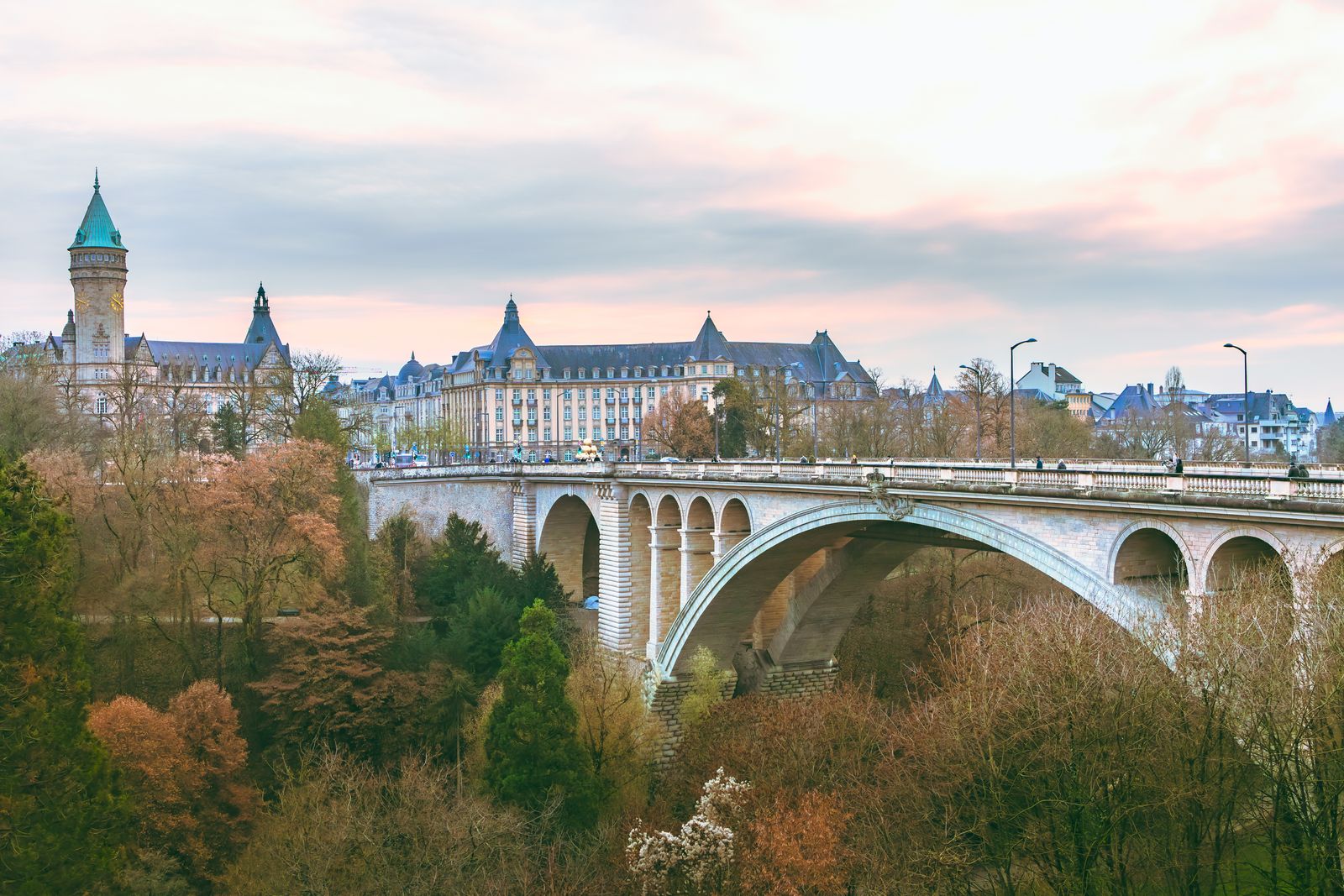
Luxembourg is one of Europe’s smallest countries and one of its most underestimated — a wealthy, trilingual Grand Duchy tucked between France, Belgium and Germany with an UNESCO-listed capital city, castles in the Ardennes (above all Vianden), and a wine region of quality that surprises visitors. Luxembourg City‘s old town, perched on dramatic sandstone cliffs above the Alzette and Pétrusse rivers, is one of the finest small capital cities in Europe — its fortifications, bridges and panoramic viewing points creating a theatrical urban landscape unlike anything else. The Moselle Valley produces excellent Riesling and Crémant; the Mullerthal region (“Little Switzerland”), gateway to Echternach offers beautiful walking through eroded sandstone formations.
The UNESCO-listed old quarter sits above a gorge — the Bock promontory, a natural fortress rising 60 metres above the Alzette River, held a fortification since 963 AD. The Grand Ducal Palace, Notre-Dame Cathedral, the Place d’Armes and the remarkable Casemates — 23 kilometres of underground tunnels and vaults carved into the sandstone cliff — form one of Northern Europe’s finest historic ensembles.
Perched above the Our Valley in northern Luxembourg, Vianden Castle is one of the most striking medieval fortresses in the Benelux region — a vast 10th–14th century complex with great hall, chapel and keep, restored in the 1970s to something close to its medieval splendour. Victor Hugo kept returning to the village below; you will see why.
A region of eastern Luxembourg characterised by eroded sandstone formations, mossy gorges, trickling streams and marked walking trails. The 112-kilometre Mullerthal Trail is one of Luxembourg’s finest long-distance walks, passing through beech forests and climbing over dramatic rock formations. The small towns of Echternach and Larochette make quiet, sensible bases.
Luxembourg’s 42-kilometre Moselle wine road follows the river border with Germany through vineyards producing excellent Riesling, Pinot Gris, Pinot Blanc and sparkling Crémant de Luxembourg. The cellars at Remich and the cooperative cave at Wellenstein are open for tastings; the vine-covered slopes in autumn are impressive.
Cured pork collar with broad beans and potatoes — the national dish of Luxembourg, eaten year-round in traditional restaurants.
Potato pancakes with herbs and spring onion, sold at markets and Christmas fairs — Luxembourg’s best street food.
The Moselle valley produces dry Riesling and Crémant de Luxembourg sparkling wine, rarely seen abroad.
Green bean soup with potatoes, bacon and cream — often called Luxembourg’s national soup.
Flour dumplings served with bacon and cream or butter — a traditional comfort dish.
Luxembourg Findel (LUX) is a surprisingly well-connected hub given the country’s size. Luxair, Ryanair and easyJet serve the main routes. The country is also perfectly central for rail from Paris (2h), Brussels (3h) and Frankfurt (3h20). For trip planning, see the official Luxembourg tourism portal.
easyJet and British Airways both serve Luxembourg from London in under 2 hours. Luxembourg City is also 2h by Eurostar + TGV from London St Pancras (via Paris).
Luxembourg is at the dead centre of the Western European rail network — it’s faster to reach from Paris (2h) than many French provincial cities. Eurostar + TGV from London is under 4h total.
All public transport in Luxembourg is completely free — the free bus from the airport to the city centre is a good introduction to this unique policy. The free train network connects Luxembourg City to all major towns including Clervaux (1h20), Ettelbruck (45 min) and Wasserbillig (30 min).
Luxembourg is 82km at its longest point — every destination in the country is within 1h30 of the capital by car. Car hire (€40–80/day) is worth it for the Ardennes and Müllerthal where bus frequency is lower.
May to September is the best window — the Ardennes forests green, Luxembourg City’s fortifications at their most photogenic, outdoor cafe life along the Place d’Armes. June and July are warmest (18–22°C). December brings one of the finest Christmas markets in Europe.
📅 Luxembourg is in its best season in May, June, July, August, September. See where else is good to go in those months, or browse where to go by month.
Luxembourg is the wealthiest country in the EU by GDP per capita and has prices to match. It uses the euro. Budget travel is feasible using public transport (Luxembourg City has free public transport) and self-catering.
Luxembourg made all public transport free from 1 March 2020 — the first country in the world to do so.
Crémant de Luxembourg (méthode traditionnelle sparkling wine from the Moselle slopes, produced by Bernard-Massard and Desom, from Pinot Blanc, Auxerrois and Riesling grapes) is the Grand Duchy’s finest export.
Luxembourg City has 2 Michelin-starred restaurants: Mosconi (Italian-Luxembourgish cuisine on the Alzette waterfront, 2 stars) and Clairefontaine (classic French, place Clairefontaine, 1 star).
Luxembourg City for two days, the Müllerthal Trail for one, the Moselle Valley for one, Vianden for one, the Ardennes for one, Esch-sur-Sûre for one. Luxembourg — Europe’s last remaining Grand Duchy — packs extraordinary diversity into a country the size of a large English county.
Luxembourg City — a UNESCO World Heritage capital — is built on a dramatic sandstone promontory split by two river gorges (the Alzette and Pétrusse). The Bock Casemates (a 23km network of underground tunnels hewn from the rock over four centuries, housing up to 35,000 troops and horses, the most extensive military underground network in Western Europe) and the Old Quarter (Grund — a perfect medieval village in the valley far below the plateau city).
Luxembourg City has been described as the “Gibraltar of the North” — its rock fortress was so formidable that it was razed in 1867 under the Treaty of London to prevent it becoming a destabilising military strongpoint. The dismantling took 16 years; 24km of fortifications were removed, leaving the 23km of underground casemates as the only surviving military infrastructure.
The Chemin de la Cornière (“the most beautiful balcony in Europe” — a 500m pedestrian path carved into the cliff above the Grund, with views over the valley, the church spires and the Alzette river below) and the National Museum of History and Art (the finest collection in Luxembourg, with a Gallo-Roman floor, medieval art and a modern collection strong on COBRA movement painters).
The COBRA movement (Copenhagen–Brussels–Amsterdam, 1948–1951) was the most important post-war avant-garde movement in continental Europe — painters including Asger Jorn, Karel Appel and Corneille produced expressive, spontaneous work influenced by children’s art and folk tradition. Luxembourg’s MNHA has one of the largest COBRA collections in Europe.
40km from Luxembourg City. The Müllerthal Trail (112km of marked paths through sandstone gorges, through narrow clefts between 20m boulders, past waterfalls and beech forest) — the day section through Schiessentumpël (a triple waterfall dropping in tiers through a sandstone arch, the most photographed landscape in Luxembourg) and the rock formations of the Heringsberg.
The Müllerthal region is called “Little Switzerland” — a comparison to the Saxony Switzerland of Germany rather than the Alps. The sandstone formations were created when Jurassic sandstone deposited in a shallow sea was uplifted and then carved by glacial meltwater during the Pleistocene into the maze of clefts, towers and overhangs that characterise the region.
50km from Luxembourg City. The Moselle Valley — the Luxembourg section of the Moselle (from Schengen to Wasserbillig along the German border) is one of the sunniest parts of the Grand Duchy, with the Remich wine town, the Caves Bernard-Massard (champagne-method sparkling wine cellars open for tours), and the Schengen village (where the Schengen Agreement — which abolished passport controls between most EU states — was signed in 1985 on a boat in the river).
The Schengen Agreement was signed on 14 June 1985 aboard the MS Marie-Astrid moored on the Moselle at the point where Luxembourg, France and Germany meet — the tripoint visible from the Schengen village. It abolished passport controls between the original 5 signatory states; today 27 countries are in the Schengen Area, allowing 425 million Europeans to cross borders without showing identity.
80km from Luxembourg City. Vianden — a perfectly preserved medieval town in the Our valley below the most dramatically sited castle in the Benelux (Vianden Castle, 11th–14th century, restored, perched on a steep forested hill above the valley with a Romanesque chapel and the largest set of residential rooms in a Benelux castle) and the Victor Hugo Museum (Hugo spent time in exile in Vianden in 1871).
Victor Hugo spent three months in Vianden in 1871, in exile after opposing Napoleon III. He wrote prolifically during this period and his letters describe the valley as one of the most beautiful places in Europe. The house where he stayed is now a museum; he drew extensively and the sketches of the castle and valley are among his finest drawings.
The Luxembourg Ardennes (the northern third of the country, dense beech and oak forest with the Clervaux Castle — home of Edward Steichen’s “The Family of Man” photography exhibition, UNESCO Memory of the World, 503 photographs from 68 countries exploring universal human experience) and the Wiltz Amphitheatre.
“The Family of Man” (created by Edward Steichen for MoMA New York in 1955, the most visited photography exhibition in history — 10 million visitors in its original touring version) has been permanently installed in Clervaux Castle since 1994 in a purpose-designed UNESCO-listed installation. Luxembourg was the home country of Steichen’s family.
20km from Clervaux area. Esch-sur-Sûre — a village of 300 people in a perfect horseshoe bend of the Sûre river, with an 11th-century castle tower on the ridge above and the river making a 270-degree loop around the village below — one of the most beautifully situated villages in the Benelux. The Sûre River Valley walk back to Luxembourg City region. Fly from Luxembourg Findel (LUX).
The Sûre river makes a complete horseshoe at Esch-sur-Sûre — the village occupies an almost-island of land nearly encircled by the river, with cliffs on three sides and the castle controlling the only land access. The medieval village layout has not changed since the 12th century. It receives 300,000 visitors per year despite a resident population of 300.
🛂 Entry rules: EES and ETIAS
Luxembourg is in the Schengen area, which has two EU border systems for non-EU visitors.
EES (in force): since 10 April 2026 the EU’s Entry/Exit System registers non-EU visitors’ passport details, fingerprints and a photo the first time they enter the Schengen area, replacing passport stamps. Allow extra time at the border on your first trip; later crossings are quicker. EU, EEA and Swiss citizens are not registered.
ETIAS (not yet running): a €20 online travel authorisation for visitors who don’t need a visa, such as UK, US, Canadian and Australian citizens. It hasn’t started and no start date has been confirmed, so nobody can apply yet; ignore websites that offer to “pre-register” you for a fee.
Visa-free visitors can stay up to 90 days in any 180-day period across the whole Schengen area, not per country.
Official information: EU: Travel to Europe (EES & ETIAS) · Reviewed September 2026
Public transport (train and bus) is completely free throughout Luxembourg — a world first. Luxembourg City is walkable; trains reach Vianden via a bus connection.
Luxembourg has free public transport nationally since 2020 — all trains, buses and trams are free. No ticket required. This is the world’s first country with free national public transit.
Luxembourg City is one of the most expensive cities in Europe. Budget EUR 30+ for lunch; evening meals EUR 50+ in central restaurants.
The old city is compact and entirely walkable. The Chemin de la Corniche (“Europe’s most beautiful balcony”) is a 30-minute walk with panoramic views of the Alzette Valley.
LUX airport is 6km from the city centre. Well connected to European hubs; no intercontinental direct flights.
Luxembourg is one of Europe’s most expensive countries for accommodation and restaurants; day-tripping from Brussels (1.5h by train) or Trier (45 min) is practical.
Most Luxembourgers speak excellent English; French and German are also widely used. Luxembourgish is the national language but rarely used with visitors.
Quick answers to the questions people most often ask before visiting Luxembourg.
May to September is the best window — the Ardennes forests green, Luxembourg City's fortifications at their most photogenic, outdoor cafe life along the Place d'Armes. June and July are warmest (18–22°C).
Luxembourg Findel (LUX) is a surprisingly well-connected hub given the country's size. Luxair, Ryanair and easyJet serve the main routes. The country is also perfectly central for rail from Paris (2h), Brussels (3h) and Frankfurt (3h20).
Expect roughly €70–110 a day on a budget and €160–280 mid-range, or €400+ for a more luxurious trip, per person and excluding flights.
Luxembourg uses the euro (€).
Plug types: Type C / F (two-pin, 230V).
— Luxembourg’s official transport app for public buses, trains and trams — though transport is free, the app provides timetables and route planning.
Free— Official tourism app with destination guides, trail maps and event listings.
Free— Excellent coverage throughout Luxembourg including walking trails.
FreePoint your camera at menus, signs or street text for instant translation. Download the language pack offline before you arrive for full use without data.
FreeReal-time and offline exchange rates for all world currencies — converts prices instantly so you always know what you are paying in your home currency.
FreeFind and book hotels, guesthouses and apartments with free cancellation on most rates — one of the widest selections of accommodation worldwide.
FreeLuxembourg sits within easy reach of several other destinations — each with a completely different character.


