PL
Poland
Old squares with stories to tell
Old squares with stories to tell

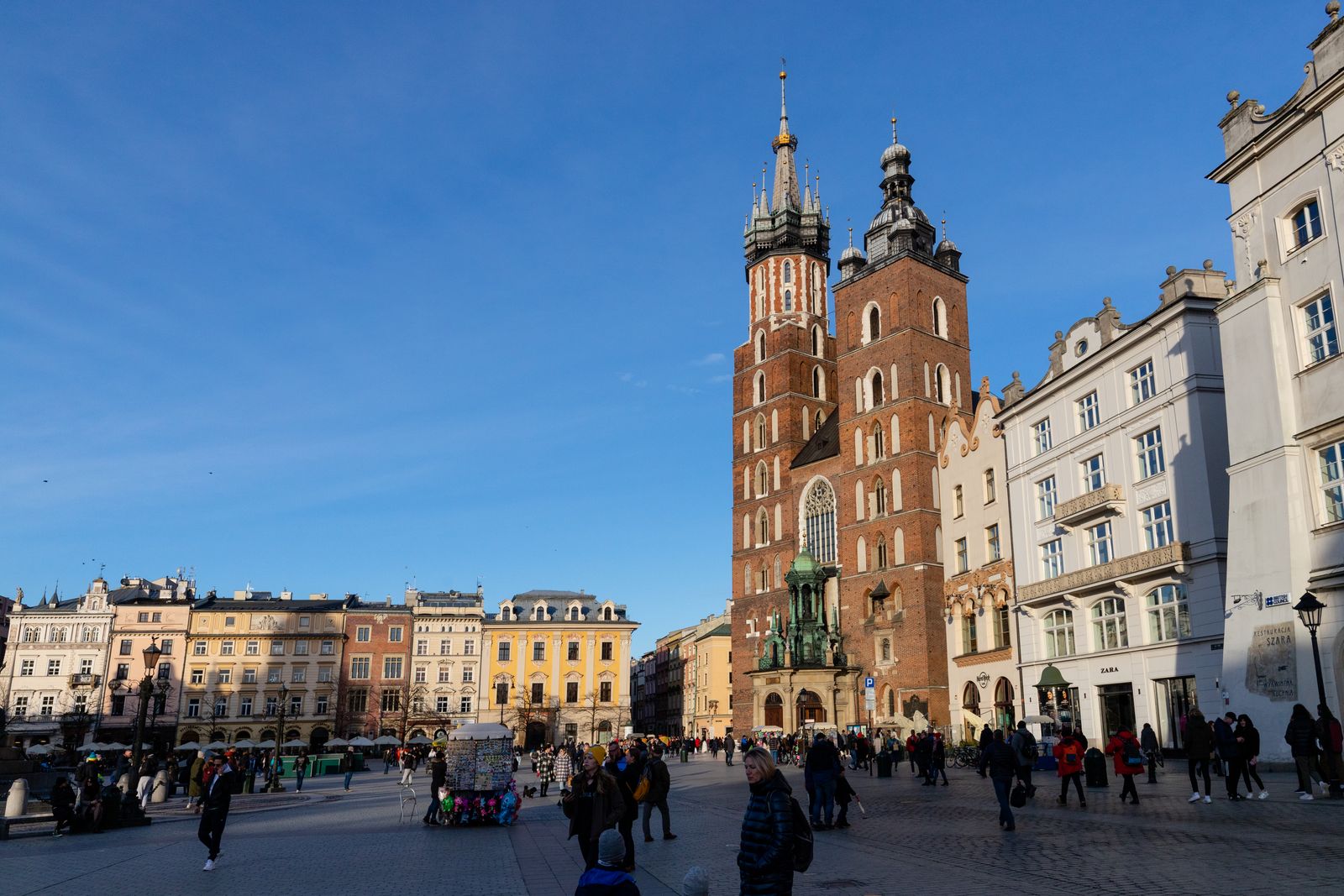
The largest medieval market square in Europe (Rynek Glowny), the Cloth Hall’s amber and folk art, the Wawel Castle above the Vistula River and the Kazimierz Jewish quarter – all in one walkable historic centre.
Photo: Igor123121, CC BY 4.0
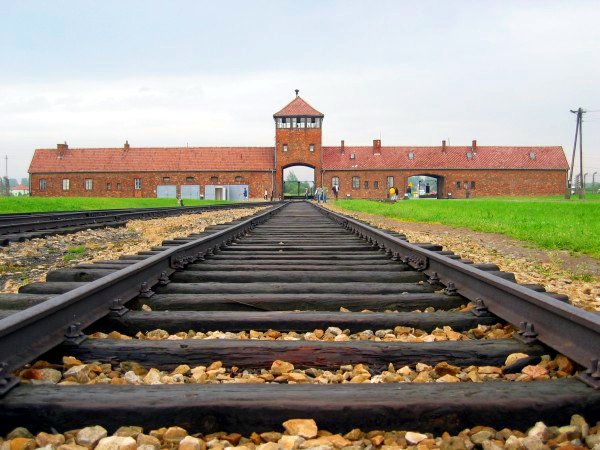
The former Nazi concentration camp complex: 1.1 million people were killed here. The most important historical site in Europe. Allow 4 hours; book timed-entry tickets in advance through the memorial website.
Photo: Wikimedia Commons contributor, CC BY-SA 3.0

A UNESCO-listed old town that was reconstructed from zero (from 18th-century paintings by Canaletto) after 85% destruction in WWII. The Warsaw Uprising Museum (1944) is one of the finest historical museums in Europe.
Photo: LoMit, CC BY-SA 4.0

A UNESCO salt mine 14km from Krakow: 300km of underground tunnels with sculptures, reliefs, chandeliers and an entire cathedral (Chapel of St Kinga) all carved from salt.
Photo: Kriskros, CC BY-SA 3.0 pl

The traditional mountain resort at the foot of the Tatras: the Morskie Oko lake (accessible by horse-drawn carriage or foot), skiing from December to March and the folk architecture of the Podhale culture.
Photo: Piotrek™ at German Wikipedia, CC BY-SA 2.0 de

The last primeval lowland forest in Europe, UNESCO World Heritage, shared with Belarus: 800 European bison (the world’s largest land mammal after the horse) roam freely.
Photo: Juan de Vojníkov, CC BY 3.0

The reconstructed Hanseatic merchant city on the Baltic: the Long Market, St Mary’s Church (the world’s largest brick church), the Solidarity Shipyard where the Solidarity movement was founded in 1980.
Photo: Qkiel, CC BY-SA 4.0

A Central European city of 14 islands on the Oder River, 300+ bridges and 300 small gnome figurines hidden throughout the old town – a playful and historically complex city that most visitors miss.
Photo: Jar.ciurus, CC BY-SA 3.0 pl
Stuffed wheat-dough dumplings: ruskie (potato and white cheese), kapusta i grzyby (sauerkraut and mushroom) or z miesem (meat). Boiled then sometimes pan-fried in butter. Poland’s most loved dish.
A slow-cooked hunter’s stew of sauerkraut, fresh cabbage, various meats and kielbasa, reheated over several days until the flavours concentrate. Better on the third day than the first.
A sour rye soup with hard-boiled egg and white sausage, served in a bread bowl. The classic Polish Easter dish; eaten year-round at traditional restaurants.
A half-baguette topped with mushrooms, cheese, ketchup and spring onion, grilled until the cheese bubbles. Poland’s most loved street food, sold from kiosks since the communist era.
Poland and Russia dispute the origin of vodka. Polish Spirytus (96% alcohol, medical grade) is the world’s strongest commercial spirit. Wyborowa, Belvedere and Chopin (potato-based) are the premium brands.
Poland’s two dominant lagers. Zywiec’s Pils is the benchmark; the craft scene in Warsaw and Krakow has expanded dramatically.
A smoked sheep’s cheese from the Tatra Mountains, made in a distinctive spindle shape and grilled, served with cranberry jam. Sold by highlanders (gorale) at the Zakopane market.
Strong black tea drunk with lemon and sugar from a glass. Poland’s national non-alcoholic drink; coffee culture is emerging fast in the major cities.
Warsaw Chopin (WAW) is the main hub; Kraków (KRK), Wroclaw (WRO), Gdańsk (GDN) and Katowice (KTW) all have good European connections. PKP Intercity trains connect the main cities. For trip planning, see the official Poland tourism portal.
Wizz Air and Ryanair serve multiple Polish cities from UK regional airports — often under £40 booked ahead. Flying into Kraków and out of Warsaw (or vice versa) avoids backtracking.
LOT Polish Airlines is the national carrier — comfortable, well-priced on transatlantic routes. Warsaw is also served by most major European carriers via their hubs.
Book on intercity.pl or Koleo. The Pendolino (EIP) is the fastest and most comfortable — worth the small premium over standard IC on the Warsaw–Kraków route.
Use Bolt (the dominant rideshare in Poland) rather than unmarked taxis — the pricing is transparent and significantly cheaper than flagging down a taxi at the airport.
May to September is the warmest window, with June and September the sweet spots. July and August bring summer heat and Kraków’s peak crowds. December brings the Christmas markets and a certain atmospheric grimness that suits the history.
📅 Poland is in its best season in May, June, July, August, September. See where else is good to go in those months, or browse where to go by month.
Poland is among the best-value destinations in the EU — comparable to Budapest and Prague in cost, and significantly cheaper than Western Europe for everything from accommodation to restaurant meals.
A Bar Mleczny (milk bar — subsidised communist-era canteen still operating) serves a full hot lunch for PLN 10–20 (€2–5). The food is real Polish cooking, not tourist fare.
A Polish restaurant meal at a good Warsaw or Kraków restaurant — żurek (sour rye soup), pierog with meat, a large Zywiec beer — costs PLN 60–90 (€14–21). This is mid-range.
Senses in Warsaw and Bottiglieria 1881 in Kraków are both Michelin-starred — tasting menus at €60–100pp, good value by any European standard.
Warsaw for WWII history and modern energy, Auschwitz for the most important site in 20th-century Europe, Kraków for the medieval city, Wroław as a surprise final destination.
Warsaw was 85% destroyed in WWII and almost entirely rebuilt. The Old Town is a reconstruction — but beautifully done, and knowing the history makes it more affecting. The Warsaw Rising Museum (1944 Uprising) is essential.
The Warsaw Rising Museum (Muzeum Powstania Warszawskiego) is one of the finest historical museums in Europe. Allow at least 3 hours. It doesn’t pull punches.
The Soviet-era Palace of Culture and Science — a gift from Stalin, loathed and then oddly beloved — has an observation deck with the best view of Warsaw. Afternoon: Praga, the working-class east-bank district, now creative and gentrifying.
The Neon Museum in Praga preserves Warsaw’s Cold War neon signs — artefacts of a lost visual culture. Small and cheap to enter.
2.5h bus or train from Warsaw, or 1.5h from Kraków. Book a guided tour at auschwitz.org well in advance — independent visitors need a timed slot. The site requires 4–5 hours minimum. Both Auschwitz I and Birkenau.
This is not a comfortable day. It’s also non-negotiable if you’re in Poland. Book the official guide — the context and narration matter enormously.
1.5h by Pendolino express from Warsaw. The Rynek Gówny (main market square) is the largest medieval square in Europe and still the centre of city life — cafes, horse-drawn carriages, flower stalls. The Wawel Castle on the hill above.
Kraków survived WWII largely intact — one of the few Polish cities that did. Its medieval streets are why it’s the most visited city in Poland.
Kazimierz — the former Jewish quarter — is now Kraków’s most interesting neighbourhood: Jewish heritage, galleries, the best bars and restaurants. Afternoon: the Wieliczka Salt Mine (30 min outside Kraków) — a UNESCO site, 300m underground, with a chapel carved entirely from salt.
The Wieliczka Salt Mine takes 3 hours. The Chapel of St. Kinga, with its chandeliers and altarpieces all carved from salt, is one of the most striking underground spaces in Europe.
3h train from Kraków. Wroław (Breslau in German, Silesian history overlapping Polish, German and Czech) has the most beautiful market square in Poland and a university with a ceiling painted by a court painter for the Habsburg emperor.
Wroław has a city-wide scavenger hunt of bronze dwarf statues (Krasnale) hidden throughout the city — over 700 of them, each with a different trade or personality. Children love it; adults too.
Return to Warsaw for international flights (3.5h by Pendolino) or fly direct from Wroław airport (WRO). Both options work well.
easyJet, Ryanair and Wizz Air all serve Wroław (WRO) with direct UK, German and Dutch connections — useful for avoiding Warsaw on your return.
🛂 Entry rules: EES and ETIAS
Poland is in the Schengen area, which has two EU border systems for non-EU visitors.
EES (in force): since 10 April 2026 the EU’s Entry/Exit System registers non-EU visitors’ passport details, fingerprints and a photo the first time they enter the Schengen area, replacing passport stamps. Allow extra time at the border on your first trip; later crossings are quicker. EU, EEA and Swiss citizens are not registered.
ETIAS (not yet running): a €20 online travel authorisation for visitors who don’t need a visa, such as UK, US, Canadian and Australian citizens. It hasn’t started and no start date has been confirmed, so nobody can apply yet; ignore websites that offer to “pre-register” you for a fee.
Visa-free visitors can stay up to 90 days in any 180-day period across the whole Schengen area, not per country.
Official information: EU: Travel to Europe (EES & ETIAS) · Reviewed September 2026
Both work in Warsaw, Krakow, Wroclaw and Gdansk.
A restaurant meal: PLN 30-60 (EUR 7-14). Accommodation is comparably cheap.
Warsaw to Krakow: 2h15. Warsaw to Gdansk: 2h45. Book at intercity.pl.
Initial formality gives way quickly to genuine warmth and engagement.
A pint in Kazimierz: PLN 12-18 (EUR 3-4). The same quality as anywhere in Europe at a fraction of the price.
The Auschwitz-Birkenau memorial sells all timed-entry tickets online at auschwitz.org. Walk-ins are not always available.
Sundays are quiet; many businesses close. The church is central to most Polish communities outside the major cities.
No need for bottled water.
Quick answers to the questions people most often ask before visiting Poland.
May to September is the warmest window, with June and September the sweet spots. July and August bring summer heat and Kraków's peak crowds.
Warsaw Chopin (WAW) is the main hub; Kraków (KRK), Wroclaw (WRO), Gdańsk (GDN) and Katowice (KTW) all have good European connections. PKP Intercity trains connect the main cities.
Expect roughly PLN 120–200 (about €28–47) a day on a budget and PLN 300–500 (about €70–117) mid-range, or PLN 700+ (about €163+) for a more luxurious trip, per person and excluding flights.
Poland uses the PLN.
Plug types: Type C / E (two-pin, 230V).
Poland’s national rail app — book IC and TLK intercity trains between Warsaw, Krakow, Gdansk and Wroclaw.
FreeThe dominant ride-hailing app in Warsaw, Krakow and all major Polish cities — often cheaper than Uber.
FreeBook Auschwitz tours, Krakow walking tours, Warsaw Uprising Museum tickets and Polish experiences.
FreePoland’s leading transit planner — covers Warsaw, Krakow and all Polish city bus and tram networks.
FreeExplore Poland’s top city destinations — from Warsaw to Kraków, each with its own distinct character.
Poland sits within easy reach of several other destinations — each with a completely different character.


